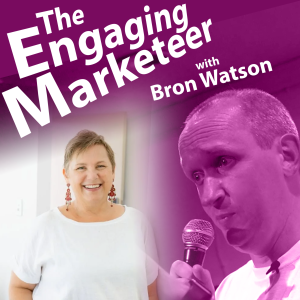
Darren Jamieson: On today’s episode of The Engaging Marketeer, I am speaking with Bron Watson, uh, who is The Social Coach based in Australia. So, for me right now, it’s very early in the morning, and for Bron, it’s very late in the evening because that’s the way time works. I’m going to be talking to Bron about how she found me through LinkedIn and through BNI and how she helps people with their their social media and not just getting a name out there and posting on social media, but actually getting raving fans and followers through social media because that’s what it’s all about.
Darren Jamieson: [01:09] But we’re also going to be talking uh quite at length about Bron’s cancer diagnosis um for two types of cancer. So warning, this might be quite triggering, but it is definitely uh an interview that you want to be listening to. So let’s find out more about Bron Watson, The Social Coach.
Darren Jamieson: [01:28] Hello.
Bron Watson: [01:30] Hello. Hello. How are you?
Darren Jamieson: [01:35] Good evening, Bron. How are you?
Bron Watson: [01:38] Good morning. This is weird.
Darren Jamieson: [01:42] This is weird. We can do this. I know we can. What’s in your coffee cup?
Bron Watson: [01:46] Oh, it’s just black coffee.
Darren Jamieson: [01:49] Black coffee. Well, I’m actually going decaf. There’s no wine. See, I have proof. There’s no wine.
Bron Watson: [01:56] Oh, it’s off. Look, I wish. All right. But it doesn’t go well with anti-cancer drugs. So, you know.
Darren Jamieson: [02:01] Well, you know, funny story. Um, in the UK we’re always told you’re not allowed to have alcohol with like antibiotics and stuff like that. But do you know that a lot of the time it’s actually not true? You can drink alcohol with various different drugs.
Darren Jamieson: [02:16] Do you know the reason they used to tell you not to do that? So you wouldn’t get pissed.
Bron Watson: [02:27] Well, partly partly that was the the build-up to it.
Darren Jamieson: [02:34] It’s because most people in in the UK sort of like 19th century, you know, 1800s that were on those kind of drugs were on it for sexually transmitted diseases.
Bron Watson: [02:41] Oh, great. Okay.
Darren Jamieson: [02:43] They told them not to drink with the drugs because they would drink, get pissed, go out and sleep with other people and pass on the sexually transmitted diseases.
Bron Watson: [02:48] They’re nasties. They keep the little creepy crawlies to themselves.
Darren Jamieson: [02:53] Exactly. So they tell you don’t with the drugs because it’s just a traditional thing they’ve always said because they don’t want you going out and passing illness to other people.
Bron Watson: [03:04] No, the vast majority of drugs and and do don’t do take advice from a doctor. Don’t take my word for it. The vast majority of drugs it is actually okay to drink alcohol with. They just tell you not to because that’s what they do.
Darren Jamieson: [03:15] Well, there you go. Well, no one can catch what I’ve got. First things first.
Bron Watson: [03:22] Exactly. No, it just I don’t know what it is. I just think it’s, look, I don’t mind the old French martini. All right. So, if I’m going to have a drink, I’ll have a French martini.
Darren Jamieson: [03:27] What’s a French martini as opposed to a normal martini?
Bron Watson: [03:33] Well, it’s got uh Chambord. Okay. Vodka, pineapple juice, and I think that’s maybe sparkling water, maybe soda water, maybe.
Bron Watson: [03:46] Give it a little shake. In she goes. Bit of fairy floss or a bit of dried up orange, whatever tickles your fancy. And whacko. It’s a really yummy, ’cause yeah, it’s a really nice drink.
Darren Jamieson: [03:59] There you go. Cheers to you.
Bron Watson: [04:01] Cheers to me.
Darren Jamieson: [04:02] But you’re not drinking one now, of course, ’cause you you…
Bron Watson: [04:04] No, I’m going the goddamn decaf. How boring is that?
Darren Jamieson: [04:10] Well, so boring. I didn’t want to. So boring. You know, anybody threatens me with decaf, I push them out the window.
Bron Watson: [04:15] Um, I know. I know. A swear word in this office. Decaf.
Darren Jamieson: [04:20] Lucky I’m not there then. You couldn’t be further away, could you?
Bron Watson: [04:26] You couldn’t be…
Darren Jamieson: [04:28] Why, if I tried? I’m just closing off a few things. There we go.
Bron Watson: [04:32] Oh, are you all right? You closed off a few things.
Darren Jamieson: [04:34] I’m done now. I’m all good. I’m sorry.
Bron Watson: [04:36] Are you done? That was fast.
Darren Jamieson: [04:37] Yeah. Yeah.
Bron Watson: [04:38] That’s all right. I just…
Darren Jamieson: [04:40] We better crack on then. Really? Haven’t we?
Bron Watson: [04:43] Well, that’s it. I I don’t even know what we’re talking about, but I’m sure it’ll just happen. I’m sure you’ve got a plan of some description.
Darren Jamieson: [04:49] I have no plan. No, no, no. I mean, I think we started, you know, the guys will probably leave that bit in at the beginning because, you know, why not? It was funny.
Darren Jamieson: [04:59] Um, so let’s just motor on with it. You know, you you started by mentioning you’re you’re not drinking wine because it doesn’t go with the drug. So, do you want to elaborate on what that is?
Bron Watson: [05:07] Well, there’s one way to bring the mood down in a in a 30 second spiel. All right. Okay.
Bron Watson: [05:12] So, um rollercoaster. We’ll go up and down. Oh. Uh look. Yes. Well, that’s a bit like what it’s like.
Bron Watson: [05:20] So, um look, I’m a nurse educator in my previous life, like way back in the day. Been there for a long time. Had a dual career in marketing, would you believe? And started my own business in 2012 out there.
Bron Watson: [05:32] Grew this ridiculous business which was great. I did exactly what all the mentors and everyone tells you to do. Um and then in 2017 I was diagnosed with breast cancer. So at 48 along comes this breast cancer diagnosis.
Bron Watson: [05:51] And when you’re running your own business you don’t exactly plan for things like that and treatment. So that was sort of like the biggest epiphany which was okay how do we get here but what’s next?
Bron Watson: [06:03] Uh fast forward a few more years and in 2023 I was then diagnosed with multiple myeloma which is an incurable blood cancer basically.
Bron Watson: [06:10] So I’ve had a curable cancer and now I’ve had an incurable cancer and it’s it’s been one hell of a ride and all the way through there of course I’ve been running my own business in marketing.
Bron Watson: [06:29] So, it’s just been this pretty darn crazy ride. And but it’s taught me so much about business, about myself, about life, and being able to build a space, what I now call The Serenity Project.
Bron Watson: [06:42] So, this is where I’m beta testing myself and basically finding a space. I call it the third space, which is between science and soul, evidence, and perspective.
Bron Watson: [06:56] So it’s a space where no matter what in your life is going on, no matter what adversity or in my case cancer and no matter what prognosis they try to throw at you, every single one of us can go on a path of what I call healing.
Bron Watson: [07:12] So what that means for someone who doesn’t have uh a you know an illness that is potentially going to shorten their life, adversity comes, you know, Darren, no doubt you’ve had adversity over the years, right? And it’s just a way of of living out the best you can be.
Bron Watson: [07:27] And in my case, not having wine. So, some prices are too much to pay. Look, you know what? I could have done with something a little less dramatic. Let’s be honest.
Bron Watson: [07:44] But, um, I’m so grateful. I call like the gratitude and grief can absolutely live in the same lane, believe it or not. Um, yes, you can learn it. It’s not, it doesn’t come naturally.
Bron Watson: [08:00] So, and it’s just about not an either or an or. It’s an and. It’s like it’s in treatment. It’s an and it’s it’s, you know, western medicine and alternative medicine. It’s grief and gratitude. It’s fear and flexibility.
Bron Watson: [08:19] So, it’s just this, but it’s learned. You can learn and laugh and enjoy life to the full. Um, I’m in remission. I am fantastic and I’m as good as my last blood results which come out on maybe Wednesday. So, doing great in all seriousness.
Darren Jamieson: [08:25] Well, no, that is good. That is that is good.
Darren Jamieson: [08:30] And do you know you’re you’re the third person I’ve had on this podcast that has talked about this and this and this as opposed to or because the first two were both improv performers.
Bron Watson: [08:44] Oh, really?
Darren Jamieson: [08:45] If you’ve done improv or if there’s just a complete coincidence there, but with improvisation. So, you know, you get up on stage and somebody gives you a scenario and you’re taught to do this and this instead of or, but it works in sales as well.
Darren Jamieson: [09:03] So, or is a blocking word that’s a negative that tells you not to do something whereas and is accept in your reality and this additional reality. So it’s interesting that you did that. Third person that’s mentioned this and as opposed to or and made the big distinction.
Bron Watson: [09:16] Well, you know, third time it’s it’s more than just a coincidence, isn’t it? It’s more than just a co It’s starting to stick.
Darren Jamieson: [09:21] So I I hope so.
Bron Watson: [09:23] Or from my rec my vocabul I can’t, I’m also going to block it from my word vocabulary.
Darren Jamieson: [09:26] Yeah. You know, it is as I said it’s it’s I didn’t choose this. Um, you know, I used to have I used to have a saying which was, um, you don’t know how strong you are until you have no choice.
Bron Watson: [09:40] Because everyone go, “Oh my gosh, Bron, you’re so strong. You’re so strong.” It’s like, you have no idea how not strong I am. I’m just not quitting. And I’m finding a path no matter what.
Bron Watson: [09:54] No matter what happens, I will still find a path. And um, no, not everyone can do that, but that’s called resilience. And you can absolutely learn it. It doesn’t come naturally.
Bron Watson: [10:06] And it’s I think it’s that split-second you know um in the road when there it just it just happens and then you run with it and you don’t know what the outcome is.
Bron Watson: [10:13] Like I don’t know what tomorrow is. I don’t know the next day. You know my week could completely change by the end of the week, I kid you not. So it’s just yeah it’s a strange thing to be honest.
Darren Jamieson: [10:29] How did it feel when you got that second diagnosis?
Bron Watson: [10:36] Oh, look, putting that into words. So, I’d only got sent to the haematologist because I’d had this. So, what fights infection? One of the things called neutrophils. It’s part of your white cells.
Bron Watson: [10:47] And they had been low for 5 years since the chemotherapy for the breast cancer. So, no one ever thought a thing of it. And so, my my doctor said, “Look, you know, I think you should go and see someone just to double check.”
Bron Watson: [11:01] Go see this person, get the bloods done, go to see to get the results. “Bron, everything is fantastic. Never have to see me again.”
Bron Watson: [11:07] Four days later, get a phone call and say, “Bron, there’s two markers, two cancer markers are really, really off. We’re going to need to do a bone marrow biopsy.”
Bron Watson: [11:19] And I’m going, “Sorry, you’ve just told me I was okay 4 days ago.” And so, you’re in a spin. And then what do you do? You go to Dr Google, don’t you?
Darren Jamieson: [11:32] Well, that Dr Google…
Bron Watson: [11:33] Um because I didn’t know what I was looking at yet. So, here I am, nurse educator, looking up things, not a haematologist, don’t know don’t know all these things about blood and I’m just reading all this horror.
Bron Watson: [11:44] And so, I live in a country town in 4 hours north of Sydney. So, things don’t move fast. So, you got to wait to get back into the specialist. Then, you’ve got to wait to get into the bone marrow, get your biopsy done, then you got to wait for results.
Bron Watson: [11:58] And so from that time, which I think was like the 14th of January, I didn’t get a formal diagnosis to the 23rd of Feb. So I literally cried for 6 weeks and I was looking at the trees going, “Please God, please believe whoever you want to believe in, God, universe, whatever you want to call it, Dennis, whoever you want to believe in, Dennis, please.”
Bron Watson: [12:17] I know it’s a joke, but I’ve talked it came up, which is a whole another conversation. It’s whoever you whoever you want to believe in, Darren. Whoever.
Darren Jamieson: [12:23] Yeah. Dennis, the dentist.
Bron Watson: [12:28] I want time. I want to have time to process because I didn’t get given time with a breast cancer. Of course, didn’t get time again. And by this stage, like the specialist already knew. He was just formalising it with this bone marrow biopsy.
Bron Watson: [12:47] But I didn’t twig or I wasn’t able to twig. So when I’m sitting there on the 23rd of Feb, I had to say to him, you know, do I have cancer?
Bron Watson: [12:55] Oh yes, Bron, you do. And you’re starting chemotherapy next week.
Bron Watson: [13:02] And so that was I cannot put into words what it’s like to walk out into the world out of a cancer institute. You’re walking out the doors and you know everyone around you is doing varying things and life is just going on and now you’re not once but you’re twice in this lane.
Bron Watson: [13:22] And going wow now what and not knowing what it all meant because remembering you don’t get all the answers at once neither should you get them all the time.
Bron Watson: [13:34] So for those who are listening please don’t get all the answers at once because you cannot process it. You simply cannot process it.
Bron Watson: [13:43] So it’s about and what I didn’t know then what I know now because I still get those left hand turns Darren is that I now will go right feel the feels.
Bron Watson: [13:53] All right you’re overwhelmed you want to cry you bawl your eyes out whereas that Bron was walking out of the cancer institute dry-eyed, husband Paul with me, we’re both in shock and getting to the car and then cry.
Bron Watson: [14:07] Whereas now I man I’d cry wherever I want. I don’t care what anyone thinks. So you feel, I feel the feels and now what I didn’t know then was I want to look at what control the controllables.
Bron Watson: [14:19] What is in my life that I can control and what can I not control which is where the whole serenity prayer comes from.
Bron Watson: [14:25] So I don’t know if you know the serenity prayer. It comes from a, you know, hi I’m Bronson and I’m an alcoholic and I don’t and I say that facetiously but in actual fact that prayer was written about 80 odd nearly 100 years ago and it is the best thing ever.
Bron Watson: [14:37] Which is God grant me serenity to accept what I cannot change the courage to change the things I can and the wisdom to know the difference.
Bron Watson: [14:45] And that is the prayer that is part of any kind of addictive treatment. But it is the best thing ever because it is so practical.
Bron Watson: [14:51] Okay, Bron, what’s out of my control? Well, what’s out of my control is what’s growing in my bone marrow right this very moment.
Bron Watson: [15:03] So, what are the control? We want to control the controllables which is not going and projecting my thoughts and my fears into the future because it hasn’t happened yet or looking back going what the hell happened why me victim.
Bron Watson: [15:21] Doesn’t mean you don’t do it. You can you can be the victim but don’t stay there. So that’s the thing where I look at the feel the feels, control the controllables, but then pause.
Bron Watson: [15:32] You literally pause and go okay, it’s absolute shock, fear, whatever you’re feeling. You pause and I reflect and then I respond.
Bron Watson: [15:40] So, I can now walk into that cancer institute knowing 100% no matter what happens in that room, I’m going to be okay.
Bron Watson: [15:48] I’m going to suck, believe you me. It’s Like, don’t get me wrong, but I’m never going to be in that absolute horror of that fear vortex, which is so real.
Bron Watson: [16:06] And it is so normal to be in that fear of that vortex of fear. But what it where I am right now is that I I get sucked in, but I get out quicker than what I did back then.
Bron Watson: [16:19] Because when you’re given a number, when you know, they give you a prognosis. For me, I was not asked whether I wanted it. Darren, I just got given it.
Bron Watson: [16:27] Oh, it’s like, would you like a cup of tea? That’s how they speak to you. That’s how I’ve spoken to. Like, and here’s your number.
Bron Watson: [16:32] I’m like, how would you Hang on a minute. Back it up there, son. Back it back it up. Where did you get that information from?
Bron Watson: [16:39] Well, Bron, you know, the average age of a person is this. And they normally do three rounds of treatment and then they give up and then they die.
Bron Watson: [16:45] And I went, I’m not 70. Or maybe I look 70, but I’m not. ’Cause it’s like, don’t put that onto me because you don’t know the answer.
Bron Watson: [16:58] And I’m not here to say to people, don’t listen to your doctor. I’m not saying that. What I’m saying is process it your way.
Bron Watson: [17:09] You know, and I’m I’m not looking for a cure. I’m not looking for a cure. I’m looking for a path of healing because I can absolutely go on a path of healing no matter how long I live for.
Bron Watson: [17:15] And I thank the squirrels. I think when I call them the squirrels, these are these beautiful, amazing researchers who are doing the most incredible things for people like me to keep us alive for as long as possible. And I’m rattling. Anyway, there you go.
Darren Jamieson: [17:31] Well done. But I have I have to ask ’cause what was the prognosis?
Bron Watson: [17:37] I don’t want to say in case my children hear this.
Darren Jamieson: [17:43] Okay, that’s fair. That’s fair.
Bron Watson: [17:45] A single digit.
Darren Jamieson: [17:48] Wow.
Bron Watson: [17:48] I’m 56 now. So, yes. And I was diagnosed at 54. So, yes, I’m in well into my single digit.
Darren Jamieson: [18:00] Wow. Okay.
Bron Watson: [18:02] Do I believe it? I do not believe it. I’m not being ignorant. What I believe in is science and I believe in soul.
Bron Watson: [18:11] I believe in what they do. When I say they, I’m talking about the, as I said before, those amazing researchers. You know, those guys are incredible of what they have done in science.
Bron Watson: [18:17] People knock it, knock chemo. Oh, you’re using that treatment. Hang on a minute. It’s my decision versus the alternative. It’s not. It’s just all treatment.
Bron Watson: [18:29] Can’t we just call it treatment because that’s what it is. And I thank them for it because you are what you know, you know, in business, Darren. We are all taught this as mentors around our mindset and the language we use to describe things.
Bron Watson: [18:41] So if we see something that is toxic, which it is, you know, I used to say in the breast cancer, oh god, I’m getting more rat poison, we know that.
Bron Watson: [18:49] But I now go in with a completely different mindset, which is I thank you scientists. I thank you for the work you have done and that you continue to do.
Bron Watson: [19:02] And Bron, I thank you for being this absolute never quitting chick who’s giving it a red-hot crack no matter what because it’s a very different outcome in terms of your brain doesn’t know the difference.
Bron Watson: [19:14] You know that. I know that. Your brain doesn’t know the difference of what you’re telling it. So, why would I bring in all this negative rubbish versus just feel the feels, control the controllables, give it a name that is right for me.
Bron Watson: [19:27] Remembering what I’m saying, guys? It’s right for me. You need to find your serenity. You need to find your way of going through it.
Bron Watson: [19:34] But it’s just this it’s really powerful, you know, and and that’s why I’m here. That’s why I’m still in remission. I do. I really truly believe that.
Darren Jamieson: [19:45] Okay. Tell me about the uh The Serenity Project. What um what inspired you to want to help other people with that as well?
Bron Watson: [19:54] Well, that’s a good question because I do ask myself on I do have good questions every now and then.
Darren Jamieson: [20:05] You do.
Bron Watson: [20:05] It’s it’s more around what how did it happen and I I question myself sometimes on the bad days like going Bron why why are you wearing m because it’s bigger than me.
Bron Watson: [20:16] The reason with because of my background because I have been a nurse educator. I’ve been in this field for decades. When you’re I’ve been down a curative path.
Bron Watson: [20:28] I’m still on the curative path. I’m just in my eighth year post breast cancer, right? So I’m still in a curative path over there and I’m still on an incurable path over here.
Bron Watson: [20:40] And when I have these very unique, they call me rare. I don’t know if it’s a compliment though to be honest.
Bron Watson: [20:47] Probably a backhanded compliment, I suspect. Like, yeah, take that, Bron.
Bron Watson: [20:52] And when you’re in that space and you’re the patient in the bed and I look back and go, “Oh my gosh, we didn’t even think about it.”
Bron Watson: [21:00] I would love to increase the the um the health profession whatever you want to call it around trauma, to trauma informed to be able to encourage healing versus solo effective treatment.
Bron Watson: [21:13] Haematologists only look at blood. Cardiologists only look at the heart. You know we I would love for which I’m sure it happens. I’m not saying it doesn’t.
Bron Watson: [21:24] What I’m saying is I’d love it to be for everyone, all inclusive, that we are all given the option to heal.
Bron Watson: [21:30] Like imagine going into your cancer institute and here you’re handed your book for treatment, Bron here, like it was read for me. Here’s your red book and it’s full of all the things that you are going to be having that you are going to sign for and have done to your body.
Bron Watson: [21:44] But Bron, here’s your pink book. It’s my favourite colour. Insert whatever book, right? But insert a book or a treatment plan which is everything else.
Bron Watson: [21:56] So Bron, here’s some things you can’t control, but heck, look at all this super cool stuff over here. And change the way we treat our patients so that everybody has that information.
Bron Watson: [22:09] I’m talking big picture here now. And I don’t always share this part of it with everyone, but The Serenity Project was born. I am the beta test.
Bron Watson: [22:14] I’ve been I’ve been doing this thing. I’ve been I’ve been writing this book for years called The Serenity Project before this second cancer diagnosis. Even before the first, would you believe?
Bron Watson: [22:21] I wrote the first chapter in 2016. I didn’t even know why I was writing it. Strange, but I did. And it’s absolutely 100% relevant to where my life is now. It’s so crazy.
Bron Watson: [22:35] I I only pulled it out a couple of years ago, and I just went, “What the heck? Where did that come from?”
Bron Watson: [22:41] So I feel that I have been given this opportunity to speak and to share while I can because it’ll be bigger than me and when I can’t speak or I’m not well there will be people who can be also carry this mission of being able to support people whether that be cancer or adversity or burnout.
Bron Watson: [23:02] We can still help our people around us by by following a really really simple method and that’s where it came from and it’s just growing and growing.
Bron Watson: [23:18] I as in I didn’t mean I didn’t even know this was coming. But I think coming from a background of running a business, you can pull this stuff off because you’ve done it before.
Bron Watson: [23:25] And coming from marketing, you know how to you know how to share the story. And so um yeah, it’s kind of weird because in my down days, Darren, I go, what am I doing? Why am I doing this?
Bron Watson: [23:39] ’Cause I’m not doing it for everyone else. What I’m doing it for is to be able to to just share some thoughts and create awareness for people to be aware that they too can go and find their serenity.
Bron Watson: [23:52] ’Cause I’m not here to tell them what to do. I’m not giving them a list of things to do. That’s not how it works. ’Cause that’s what everyone else does.
Bron Watson: [24:03] There’s no to do lists. They’re called just a thought. Have a think about it. If it resonates, great. If it doesn’t, ignore it.
Darren Jamieson: [24:09] It’s interesting you you mentioned coming from the background of running a business. One of the podcasts I recorded a couple of years ago was um with a guy called Dave Sanderson and he was one of the passengers on the flight that crashed into the Hudson in New York.
Bron Watson: [24:22] Wow.
Darren Jamieson: [24:23] And he was the last passenger off the plane. And he mentioned how because that flight they were all business people. There were no tourists. There were no kids. They were all business people. They were all leaders. Uh no nobody died.
Darren Jamieson: [24:35] Everybody organised, got off the plane, structured, people took charge what was happening and he thinks because they were all business people that they survived that without any injuries, any any fatalities.
Darren Jamieson: [24:47] Um, do you think that people in your position who are business people, who are business leaders, have an almost obligation to help others to do what you’re doing because you’re able to see things in a different way that other people perhaps would.
Bron Watson: [24:55] That’s a bloody good question. And yes, I think going to go down. There you go again. You got another one.
Bron Watson: [25:15] Uh I think what it is is that I think when you are when you start a business entrepreneurship, whatever you want to call it, you’ve had an idea and you’re literally creating something from nothing.
Bron Watson: [25:29] Whether there’s 20 florists in your area and you’re starting your own florist. You are starting something from nothing. And then you grow it. You make mistakes. You grow it. You twist. You turn. You pivot.
Bron Watson: [25:46] You do all of the things which because that’s what happens when you are you know as good you know you’re financially as good as your last invoice.
Bron Watson: [25:58] That’s one thing is employees don’t understand is that when the responsibilities of the very very many many hats that happen within a business I think you get an innate ability to make a decision.
Bron Watson: [26:03] You can make a, like you have to make a decision. For me I’ve got a team of four. I’ve got to make decisions. You’ve got your team. We have to decide and the buck stops with you.
Bron Watson: [26:16] And I think that’s when you are in business. You and I’m not doing this for business. All right. This is this is not a money-making adventure.
Bron Watson: [26:23] Yes, there’s financial parts within that. Why? Because it’s got to fund itself. You know, if you’re looking at it from a financial perspective, but it’s around what you do next, where we take that.
Bron Watson: [26:37] You know, if we’re wanting to change the way we treat and care for for cancer patients or for anyone with adversity, we we got to someone’s got to fund that eventually.
Bron Watson: [26:51] So therefore, we’ve got to have this fantastic machine that is going we are demonstrating exactly who we are and what we do. The message is very clear. Here’s our people and we all are in the same alignment.
Bron Watson: [27:03] So yes, I would say that being in business helps because I can speak one. I am an educator as in you know I am a qualified educator but also you can make a decision whether it’s right or not is irrelevant because we’ll make it right.
Bron Watson: [27:20] Like if we’re making a mistake today and people are listening to go Bron you were so full of it and said great I’m so happy you think that because you’re not my people.
Bron Watson: [27:26] So yeah I would agree with that.
Darren Jamieson: [27:34] Okay. As you’ve as you’ve mentioned, you are an educator because you’ve worked with uh nurses, haven’t you, to help them. So, you’ve seen both sides of the health care system in Australia.
Bron Watson: [27:40] I have. I have.
Darren Jamieson: [27:46] In the UK, it’s fairly well regarded that our health care system is on its arse. That it is massively underfunded. And I experienced that myself recently when I had to go to A and E with somebody and she was there from 11 in the morning.
Darren Jamieson: [28:04] She didn’t get home till just before midnight. They gave an estimate of 6 hours to see her and it was about eight or nine hours before she got seen.
Bron Watson: [28:10] Wow.
Darren Jamieson: [28:11] He was shocked ’cause she wasn’t from the UK. She’s from another country and said in that country it’s about half an hour to see somebody. Well, in Australia it can be that long. Can it?
Bron Watson: [28:23] Oh, absolutely. I I have a friend whose mother waited 11 hours the other day.
Darren Jamieson: [28:29] 11 hours.
Bron Watson: [28:29] She was seen. So that she’s triaged. So, when you work into emergency, you’re triaged and then you’re put into a category. And then depending on your category is depending on how where you are in the line.
Bron Watson: [28:43] And this woman was um I think she had a drip put in. Yes, she was. ’Cause she wasn’t eating. She wasn’t she wasn’t allowed to eat. And 11 hours she was in a chair in the waiting room.
Bron Watson: [28:55] And it’s no one’s fault. It’s the system. You know, everyone is doing the best they can with what they have.
Bron Watson: [29:05] So, yes, NHS isn’t awesome, but um yeah, I’ve been into A and E in Las Vegas. Now, that was an interesting one, I bet.
Darren Jamieson: [29:10] Yeah, that was cool. Not but anyway. What What I’ve got to ask ’cause I’ve never been to a hospital in America. I’ve heard horror. I’ve been to two.
Darren Jamieson: [29:18] Okay. What What was that like?
Bron Watson: [29:20] Uh well, the first one was, okay. So, this was up in Wisconsin and I’d broken my elbow. I I’d gone over I was speaking at a conference and all I wanted to do was see snow remembering I come from the mid north coast of New South Wales, Australia and we have very temperate and there’s no snow.
Bron Watson: [29:37] No. And I went and it started snowing and I was so excited that I put on my big fluffy hooded jacket bought especially for the trip and I jumped off a retaining wall that was maybe half a metre high.
Bron Watson: [29:50] And I stood on the retaining wall and my little ankles did this. I went, “Oh, you’ll be right.” Anyway, jumped off, fell flat on my face and broke and had my left arm under me and broke my elbow.
Darren Jamieson: [30:09] Nothing like breaking your own arm, your own elbow with your body. That’s something to be proud of, isn’t it?
Bron Watson: [30:15] It is.
Darren Jamieson: [30:16] I mean, when you talked about that, I thought you were going to say, “I’ve never seen snow.” So, I put on my winter flip flops.
Bron Watson: [30:20] Oh, look. If it was that and it was just literally fluffy. I was just like, “Oh, dear gosh, what have you done, you stupid woman.”
Bron Watson: [30:25] Anyway, so yeah, flat on my face. I literally looked like, you know, the road runner with the I’m going showing my age now. And the thing, what’s what was his name? Coyote.
Bron Watson: [30:36] And when he always fall down. Coyote. And he’d slap down onto the ground and you just see him like that. That was me.
Bron Watson: [30:44] But I had my left arm under me, so I broke my own elbow. So, you know, that’s something I’m very not proud of.
Bron Watson: [30:49] But I did go into a hospital in Wisconsin and that was pretty smooth. But then I needed to be checked by an orthopaedic surgeon in Las Vegas.
Bron Watson: [31:00] And so I had to go uh the insurance company said you’ve got to go to this particular hospital which was obviously smack in the middle of Las Vegas.
Bron Watson: [31:08] And you know you’ve got the security guard there and you’re going through security. You’re going to literally like what you go through in an airport really before you actually get into emergency.
Bron Watson: [31:20] And there was really sick people in that emergency. Remembering with my background I’m looking around going, “Oh my gosh, you were so sick.”
Bron Watson: [31:26] Uh and I’m sitting there going, “Oh, please God, don’t catch anything.” ’Cause this was in 2022. So it was um you know post-Covid but still not out of the woods.
Bron Watson: [31:34] And uh yeah so I’m very grateful that for the systems we have but yeah we go with the systems and we they’re fundamentally flawed or they’re just you know they’re doing the best they can with the funding they get but it’s not good enough.
Bron Watson: [31:46] It’s my personal opinion.
Darren Jamieson: [31:53] Do you do you think the funding is being used wisely?
Bron Watson: [31:58] Well, that’s a really another good question. Would you stop asking me these tricky questions?
Bron Watson: [32:03] No, I’m joking. Uh, good. Now, how can I answer that question? I ask it goes to a lot of people in this country in healthcare and they all say the same thing that the funding isn’t getting to where it needs to get.
Bron Watson: [32:10] It’s always being used for administrators at the top and it’s not putting people on the front line. That that’s why I asked that question.
Bron Watson: [32:22] Yeah. And and there’s just, you know, that thankfully we’re getting more nurses through. When I say registered nurses in ENs, we’re getting nurses through, but um you know, got to keep them there.
Bron Watson: [32:35] You know, it’s not an easy career. Nursing is is hard physically, mentally, like I don’t even know why I did it really, but anyway, I loved it while I was there and I’m forever grateful.
Bron Watson: [32:41] Um do I think the money goes to where we need it? It is not equitable is what it feels like, feels like to me which means that I know that within cancer there are more popular cancers than others.
Bron Watson: [32:55] So uh lymph I have multiple myeloma and it’s like the little that’s the the poor cousin of some of the other blood cancers is my opinion but remembering pharmaceuticals have a lot to play in that space as well which is where the research dollars come from.
Bron Watson: [33:08] So it depends on um you know I think it’s from my perspective if there is someone who’s not getting what they need you just keep going until you find it. You just keep asking questions.
Bron Watson: [33:20] You keep going and ask you you find people who know people who know people and you know I’ve met this most incredible doctor from Brazil because I met this guy on a on a um online summit where I was presenting and now I’ve been connected with the most incredible doctor doing the most incredible work in Brazil like fantastic.
Bron Watson: [33:37] So that’s what I’m saying is if you feel no matter where you are and you’re needing more, you just go and find. You’ve got to keep looking and finding it.
Bron Watson: [33:51] And I’m not talking about you do not need to become a scientist. I don’t need to become a scientist. I’m never going to be a scientist. I’m never going to understand the research they do.
Bron Watson: [33:57] I’m not a doctor. I don’t want to be a doctor. I am so grateful for the doctors. So I am the patient. So stay in your patient lane is what I’m saying. Stay in your lane. Whatever your lane is.
Bron Watson: [34:02] And and when it comes to knowledge, find people who know the things. And if the people don’t know them, go to someone who does. Um rather than try to become the scientist and read the peer-reviewed articles yourself because you’ll be reading stuff you have no idea what you’re reading.
Bron Watson: [34:21] Or just read the intro and the summary at the end and just leave all the rest in the middle. But yeah, dead serious.
Darren Jamieson: [34:32] There’s there’s a question I’ve been not sure whether I want to ask because I I just I I had there’s no questions off. Remember that I told you.
Bron Watson: [34:44] Well, I don’t know. This one might I’ll see if I’ll answer it.
Darren Jamieson: [34:50] Um yeah. No, it’s more opinion. There’s a lot of people and I’m not sure I agree with this myself. There’s a lot of people I’ve spoken to um conspiracy theorists who say things like um we don’t need oil anymore because electric cars have been built to a level where you won’t need oil.
Darren Jamieson: [35:08] But it’s been suppressed because it would kill the oil. Too many people would lose money. And there’s another one. Again, this one I This is the thing I didn’t I wasn’t sure to ask.
Bron Watson: [35:14] Yeah. Yeah.
Darren Jamieson: [35:20] There’s no money in curing cancer. No, there’s not. The money is in treating cancer. There is a thought among some people that a cure has already been discovered. It’s just been buried because it’s not really going to make any money. And the pharmaceutical companies are the ones that earn all of the money and they would never allow it to happen.
Darren Jamieson: [35:38] I have heard that myself. Have you?
Bron Watson: [35:44] I have. So again, uh I won’t answer my opinion other than if you are having those thoughts, you’re not alone and you keep going till you find someone who can answer the question for you.
Bron Watson: [35:56] In terms of treatment of cancer in traditional method, chemo, immunotherapy, whatever, you’re getting treated with the pharmaceutical product, but then you’re going to need drugs for the side effects of that treatment.
Bron Watson: [36:09] And then for me, I ended up on medication for the side effects on the medication for the cancer. So where I never took a tablet in my life.
Bron Watson: [36:24] Uh I’ll give you an example. Post breast cancer. I take a drug. I’m in postmenopausal now. Thank you. Chemotherapy.
Bron Watson: [36:35] Um I I take a drug called let, anti-cancer drug that you take, well, you can you can choose. Everyone has a choice up to 10 years.
Bron Watson: [36:52] So took I took that medication remembering I’m now into my second cancer. The last thing I need is another bout of breast cancer. So I’m doing all the things right.
Bron Watson: [37:05] I’m looking after my mind, body, soul. But let’s just use let the example.
Bron Watson: [37:12] And so a side effect of let is increased cholesterol. So I didn’t have cholesterol before. I now have cholesterol. I now have a cardiologist because it’s got to manage all the cardiac stuff which is related to the cholesterol.
Bron Watson: [37:24] Then you’ve got to have the CT with a calcium score to find out what your risk is of dying of a heart attack at my age. Do you see what I’m saying?
Darren Jamieson: [37:35] Yeah. It just goes on and on.
Bron Watson: [37:40] And that is the challenge is that you can say no, I do not want any of the treatment and I take my hat off and I respect anybody.
Bron Watson: [37:47] That’s what I mean about serenity. If you whatever your choice of treatment and healing is is yours.
Bron Watson: [37:53] So if you go down the track that no nothing I’m doing just all natural out of the ground. Great. It’s exactly what you’re meant to take versus people like me who want all the things because I want to have I want to live till I’m an old lady, you know.
Bron Watson: [38:16] So it’s it’s so then we have to deal with what comes next which is side effects.
Bron Watson: [38:21] Pharmaceutical companies own the drugs for the side effects, don’t they? You know what I’m saying?
Darren Jamieson: [38:26] Yeah.
Bron Watson: [38:26] So, but you can find alternative treatments to deal with those things such as, you know, um reflux or there’s so much you can take, but you know, you’ll need to find potentially a functional specialist or a functional GP or a naturopath who can help you and put you in the right direction.
Bron Watson: [38:45] And that’s why I say and take all the things if that’s what’s right for you. It’s not an either or. It’s an and for me personal opinion. And so that’s why you do whatever is right for you.
Bron Watson: [38:58] But yes, you know what I’m saying.
Darren Jamieson: [39:04] Yeah. Yeah. It’s very sad because we’ll never know. It’s a whole ivermectin story. You know, if you go and have a look at ivermectin and all the the stories with ivermectin.
Bron Watson: [39:16] Oh, so do you not remember when um what’s the Australian guy’s name? See, I’ve got this my mind problem. There’s an Australian who came out with what’s that really famous podcaster Joe? What’s his name? Yeah. So, it’s almost on the tip of my tongue.
Bron Watson: [39:35] There was a big interview done with insert Australian, I can’t remember his name. And it was all about ivermectin, right? And also and what it does for treatment of cancer.
Bron Watson: [39:48] So it’s not your standard treatment of cancer if you go to a in Australia for a traditional way of going and so it’s created a whole big hoo-ha into research around what have they done with ivermectin.
Bron Watson: [39:58] So ivermectin on its own is actually a um used on animals for a drench for worming. Right. Okay.
Bron Watson: [40:12] But, and this is what happens when you read the books, when you start looking into when your brain is able to take in information where you’re looking at medications that have been created have had these unexpected side effects, but these unexpected ways that can be used in a different way or the combinations of medication.
Bron Watson: [40:28] There’s this fantastic centre actually in Eng, good thing in this space. But if I go to my haematologist, he’s probably going to say, well, you know, Bron, that’s up to you how you want to do that. But we don’t believe that within our silo of treatment.
Bron Watson: [40:42] Right back in the beginning when I talked about silos, it’s the silos. So you want to take away the walls between the silos because then you patient, you community can then make a decision because at the moment if you don’t know where to go, you won’t get the answers.
Bron Watson: [41:04] Mhm. It’s my personal opinion.
Darren Jamieson: [41:10] Okay. Should we um should we bring it to something a bit more exciting?
Bron Watson: [41:15] Bit more? Yes. Let’s let’s talk about marketing, which is oh my god. Now I need to go to sleep. But yeah, go on.
Darren Jamieson: [41:22] No, you you’ve been in marketing a long time.
Bron Watson: [41:30] I have.
Darren Jamieson: [41:31] You you you have. You have. What um what kind of businesses have you worked with in in marketing kind of industry?
Bron Watson: [41:38] Well, I different actually. I started my very first marketing job was actually with Ticketek. So Ticketek is the one of the major ticketing companies in Australia like Ticketmaster.
Bron Watson: [41:51] And I hate them.
Darren Jamieson: [41:57] Because of the markup they make on tickets.
Bron Watson: [42:03] Correct. Anyway, so I got my very first marketing job with Ticketek and that was a great uh getting the ground running experience. Um, so that was fun and of course in the entertainment industry and you know I got to go to every musical there was and it was just I I really enjoyed my time there.
Bron Watson: [42:14] And um I then worked I’ve worked in a hospital very large hospital one of the biggest hospitals in uh in in Australia and actually in the southern hemisphere.
Bron Watson: [42:29] Uh that was I loved my time there because again I could then combine my understanding of of health and and marketing.
Bron Watson: [42:35] I’ve worked for an energy, an back in the day it was an energy retailer, energy network provider. Um yeah I’ve had some big gigs and then I started my own business.
Darren Jamieson: [42:46] Do do hospitals need marketing?
Bron Watson: [42:54] Oh yes I think so. If this was a private hospital and New South Wales Health, Australia Health has they have marketing teams. They spend a fortune on it. You mix it in marketing communications. Yeah, they definitely do.
Darren Jamieson: [43:07] I just thought, you know, broken your leg, come to a hospital.
Bron Watson: [43:14] Um, well, I think when it comes to, you know, like would do those ads. Yeah, true. Come on in. Um, yeah.
Bron Watson: [43:22] No, there’s patient booklets, there’s patient information. Like there’s, you know, you know what it’s like in marketing, external and internal. So we we it was all different kinds in that space.
Bron Watson: [43:28] And so that was I I had the most amazing boss ever. Her name was Julie. She was to this day my she was the best one of the best leaders I’ve ever seen walking and talking her her values and leadership skill.
Bron Watson: [43:45] And yeah, I loved every minute of it. So yes.
Darren Jamieson: [43:51] I mean, I was being facetious.
Bron Watson: [43:52] Of course, I know you were. And I just went, “No, we are not going to be facetious about this one.” We are not going to be facetious. No. About hospital marketing. No, no, no. It’s important.
Bron Watson: [43:57] No, look, they do have budgets. You just, you wonder where and what it does. It’s, you know, you know what it’s like in corporate marketing.
Darren Jamieson: [44:03] Yeah. Budgets need to be spent.
Bron Watson: [44:10] Budgets need to be spent or they won’t get it again next year.
Darren Jamieson: [44:16] Correct. So your your own business, what kind of…
Bron Watson: [44:22] Yes, I do run my own business.
Darren Jamieson: [44:23] You do. You you do. I know you mentioned it. What kind of people do you work with?
Bron Watson: [44:30] I love I love working with in my market. I love working with small business owners. So people who have probably sub 5 to 10 employees where they they understand the value of where marketing sits.
Bron Watson: [44:42] ’Cause in that space and I’m I’m not quite sure who you work with but you know you’re part of BNI and I’m part of BNI and those rooms are full of people who understand they know they need it but that they can think that they can do it themselves.
Bron Watson: [44:53] Or they don’t understand the strategy behind what you’re trying to achieve.
Bron Watson: [45:01] Um, and I do love working with people who are in regional areas. So, not in like, you know, I will help whoever needs help if it’s a fit.
Bron Watson: [45:06] I’m up to the stage in life where if it’s a fit, that’s great. Um, so it’s called The Social Coach. And we just, you know, I have a very unique method. I call it the Bronco method.
Bron Watson: [45:12] So, I’m very blessed, I suppose, in some ways now because of what I’ve been through to be able to bring through those decades of experience plus understanding people, I think, is the key.
Bron Watson: [45:19] And, um, yeah, I just really appreciate people who understand that they need marketing, but they also understand what it’s meant to achieve.
Bron Watson: [45:26] So, if you think you’re going to double your your money in 30 days using social media organically, great. Tell me the secret.
Darren Jamieson: [45:39] Yeah. But that’s what people’s expectations are.
Bron Watson: [45:45] Yeah. How often does they say to you, Bron, “I want to go viral. How do I do that?”
Bron Watson: [45:52] I go, lucky you. Great. Okay. Whereas my answer, my answer today is, well, congratulations. That’s fantastic. That’s a great goal. I may not be able to help you with that, but what I can help you with is getting you raving fans.
Bron Watson: [46:04] And so whether you want 200 raving fans who are going to who share and love and work with work work with you and love what you do versus 20,000 people who do nothing up to you.
Bron Watson: [46:17] How do you want your you want the cash register to ring right? That’s what we’re in business for. You want your cash register to ring.
Bron Watson: [46:25] So where are the multifaceted. So you know marketing is just one of the you know we want to I I think to me marketing is about creating curiosity.
Bron Watson: [46:32] We want to hit that curiosity button which is connect like comment share whatever that connect the curiosity is because then we’re handing it over to um sales conversion we’re handing it, we might even have advertising in there.
Bron Watson: [46:44] We all have a diff it has a different a different job to play and that’s what I think people misunderstand is what they what they think that marketing does and it’s just one one part of the whole flow.
Bron Watson: [46:50] Um that’s my take on it. What about you? What’s your take on it?
Darren Jamieson: [47:01] That’s a really good point. I’m asking you a question. You’re asking me a question?
Bron Watson: [47:08] No, I I’m asking you a question.
Darren Jamieson: [47:09] No, I I’m just saying I I like that ’cause there’s a lot of people come to us and and say things like, um, well, I want to go viral or I want to get 2,000 followers on LinkedIn.
Darren Jamieson: [47:24] I want to I want to rank above my competitor in Google for this particular keyphrase. It’s like, well, why why do you want that? Because they are there and I want to be there.
Bron Watson: [47:31] Why?
Darren Jamieson: [47:37] Correct. ’Cause I think it’s going to get me more business. It probably isn’t. It probably correct.
Darren Jamieson: [47:42] And then there’s people that go around country clubs and say things like, “I rank on the first page of Google for a search on mobile phones.” It probably is. And how many people are buy Well done you. By searching for mobile phones.
Darren Jamieson: [47:53] Well, no, no, no, none of them. They then work out what model they want and what what variation and colour of the phone they want and it’s at that point they actually make a a sale. You rank for that. No, no, no, no, no. Well done.
Darren Jamieson: [48:04] You spent millions of pounds to rank on the first page of Google for mobile phones and you’re getting absolutely sod for it. Well done. That’s brilliant.
Bron Watson: [48:10] Exactly. It’s people that don’t understand what it is they actually want. They just think they want, and and correct me. There’s there’s agencies out there that you’ll go to them and say, “Oh, I want you to um spend £2,000 a month on my Google ads and get me traffic to the website.”
Bron Watson: [48:24] Yes, I’ll do that straight away. And it might not be the right thing for them. It might not work for them. It might not get them business, but they’ll take money off them and do it anyway because it’s what they’ve asked.
Darren Jamieson: [48:29] Exactly. And that frustrates the hell out of me as well.
Bron Watson: [48:35] Me, too. And you know, it’s it’s marketing without strategy. It’s marketing without the long game, the short game, the medium game. Um because they all play a different part. And each part is meant to is is is to come together.
Bron Watson: [48:41] And you know, it could be raising awareness. It could be is it really connections? What is it exactly? What’s connections going to give you exactly?
Bron Watson: [49:01] Okay. You know what a what a like’s going to give you? What is a viral? I know there’s a business in my area where there’s been some virals. I’m talking some big virals.
Bron Watson: [49:06] Well, how did that play out in the cash register? That’s what I’m interested in. I doubt that it did because it’s what you do next.
Bron Watson: [49:11] That’s my take on it. I like to say, what are we doing next with this situation? And it’s exactly what you said about raving fans as well. It’s about turning people that have never heard of you before into raving fans and taking them through the whole process of awareness and consideration before they become sales and raving fans.
Darren Jamieson: [49:30] And it that’s right and to give them time. It need it it takes time to do that, you know, like you and I both know it doesn’t used to take even even five years ago. It take a couple of I don’t know a couple of months to to build that know you like you trust.
Darren Jamieson: [49:48] Build that to the point where that curios in my world that curiosity button is hit and they contact you for whatever reason. Now we know it’s a lot more and a lot longer.
Darren Jamieson: [50:02] So it makes it a lot harder when you’re looking for a return on investment for your time and money ’cause time is money ’cause you’re taking it away from doing something else in your business.
Darren Jamieson: [50:16] So you know and understanding where each part of the segments within marketing like okay drive traffic to the website and then what, how are you looking after them.
Darren Jamieson: [50:22] So I use five pillars which is lead generation, lead nurture, sales conversions, delivery, everyone’s really good at delivery and then referrals, upsell, onboarding business right.
Darren Jamieson: [50:29] So each one of those and you might go well I’m a I know you’re awesome at delivery but you really suck at nurture which means that you spend all that money bringing people to your website and you’ve done jack all with it.
Darren Jamieson: [50:42] Or you’re putting all this time in growing your followers on Instagram for for what purpose, you know does it fit does it not I don’t know.
Darren Jamieson: [50:56] Is all that you need, you need 2,000 connections on LinkedIn algorithm, as you know LinkedIn’s good algorithm, we like it, but what’s it designed to do.
Darren Jamieson: [51:03] In my world it’s all roads lead to Rome which is when they when they hear you. We build this. I said, I call this the backup gang. The backup gang who builds the foundation and then we layer on all the things like what you do and and other agencies.
Darren Jamieson: [51:14] We layer on to build on to the foundation. ’Cause if your foundation isn’t clear or it’s messy or it’s inconsistent, you’re stuffed as far as, do you like that technical term?
Bron Watson: [51:31] I like that.
Darren Jamieson: [51:31] Yeah. You’re stuffed.
Bron Watson: [51:38] Stuffed. You’re stuffed. Yeah. Well, you’re wasting you’re wasting your time, and time is money.
Bron Watson: [51:47] What do you think? This isn’t your podcast. I don’t care. I’m asking you a question.
Darren Jamieson: [51:53] You said we’re having a conversation.
Bron Watson: [51:54] This is true.
Darren Jamieson: [51:59] Yes. No. No. I I agree that a lot of people in marketing waste their money because they concentrate on the things they think are important, which is, for example, getting traffic to the website.
Darren Jamieson: [52:10] They think search engine optimisation is a magic bullet. Increase the traffic to their website from a 100 people a month to a 1,000 people and suddenly the business is just going to happen.
Darren Jamieson: [52:18] And it reminds me of this um this skit. I think it was from South Park where they had this plan to get rich by stealing all the pants.
Darren Jamieson: [52:24] And it was step one, steal all the pants. Step two, love it. Step two, we’re not sure of what step two is. Step three, become rich.
Bron Watson: [52:37] That is so classic in marketing.
Darren Jamieson: [52:44] Yeah. So, step one, get loads of traffic to the website. Step two, we’re not sure of. Step three, 300 grand a year additional revenue.
Darren Jamieson: [52:55] How’s that going to work? I don’t know. We’re not quite sure on step two. Don’t know. Just you. It’s your job. You go make it work.
Bron Watson: [53:01] Yeah. Yeah. Yeah. You sort it out. You sort it out. You sort it out. Yeah. Yeah.
Darren Jamieson: [53:07] No, it’s it’s just that fundamental and you know what it doesn’t have to be complicated once you know exactly what you need.
Darren Jamieson: [53:13] And that does take having conversations with people who happen to know what they’re doing.
Darren Jamieson: [53:19] And that’s where, you know, like people have the I’ve had people say to me, “Oh, you know, Bron, you’re going to be out be out of a job soon with AI.” I said, “Yes, thank you very much for that. I do appreciate your input on that.”
Darren Jamieson: [53:25] Uh it’s called context and it’s called humans. Humans need to run the little you know what if I just pull the plug on the um the power outage then it’s gone right.
Darren Jamieson: [53:36] So it’s really literally when I say figuratively speaking uh we will not be without a job. Do we need to evolve and go with it absolutely.
Darren Jamieson: [53:42] But when you’re looking at reasoning and I know it’s got reasoning in it’ll give you 81% accuracy but that’s telling me that’s 19% that’s one in five as far as I’m concerned incorrect.
Darren Jamieson: [53:56] Would Would you back a horse on that?
Bron Watson: [54:02] No, you would not. You’ve got to go and check it. So therefore, you need humans, you know, and humans understand humans.
Bron Watson: [54:08] We feed the machines. We feed AI. We give it all of the things we want. I love AI. I love it. It’s it’s a fantastic tool to speed up.
Bron Watson: [54:20] And not only that, you can you can strategise with your AI and go, “Hey, have I missed anything there?” I want you to use some cowboy theory of thinking. Go and have some fun with that.
Bron Watson: [54:27] You know, and and absolutely it’s not just about content creation and all that, excuse my language. It’s way way more than that.
Bron Watson: [54:32] If that’s all you’re using it for, I feel sorry for you, but you know what I mean. It just means you want to dig deeper.
Bron Watson: [54:38] And that’s where we human, we marketers, we we’re going to still have a place. We just got to, you know, I’m not doesn’t worry me in the slightest.
Darren Jamieson: [54:43] It is. It’s a great tool to speed stuff up. It’s a great tool to research. It’s a great tool to bounce ideas off and to summarise as well.
Darren Jamieson: [54:49] So, I’ll use it for things like this podcast, like transcripts. We’ll get a summary from AI of what we talked about, but it’s stuff we’ve already talked about.
Darren Jamieson: [55:02] What AI cannot do, what it can never do is create something original from scratch. It cannot.
Bron Watson: [55:09] Exactly. It can only rework and return what has gone before. And if it hasn’t gone before, it can’t do it.
Darren Jamieson: [55:16] Correct. So, it does. And it’s only good as what you give it.
Bron Watson: [55:25] Give it crap, yeah. You give it rubbish, you’ll get rubbish. And you won’t know you’ve got rubbish. That’s the thing.
Darren Jamieson: [55:31] That’s a developer question. That’s the um about data. In, out. You put data in, you’re going to get data out. And it’s the same with AI. And that’s what we’re doing with it.
Darren Jamieson: [55:45] “Write 10 blogs on my dental practice.” Oh dear. Better be quality, isn’t it?
Bron Watson: [55:53] Agreed.
Darren Jamieson: [55:53] Do you know we’re almost out of time?
Bron Watson: [55:59] Well done us.
Darren Jamieson: [56:00] Well done. I hope that was I hope that was useful ’cause I mean obviously.
Bron Watson: [56:05] Do you think?
Darren Jamieson: [56:05] I I think so. I think so. Yeah. We didn’t even talk about spiders and snakes once.
Bron Watson: [56:10] We did not. We did not. We did not. And we did not discuss, I tell you one thing that I I did want to mention is the power of BNI.
Darren Jamieson: [56:17] Oh yes. Go go go on then.
Bron Watson: [56:19] I really did want to mention BNI. That the reason why I did that. So let’s have it.
Bron Watson: [56:24] The reason why and it’s not not BNI, it’s networking. It’s about reaching out. All right.
Bron Watson: [56:30] So just to give some context here for your listeners is that I re I was I was searching for training for BNI. I’m the go for green coordinator which means that I’m helping members get the most out of their membership and I came across something that you’ve put out some training on BNI.
Bron Watson: [56:44] So, I got your free thing, got you in the sales funnel, and then I purchased because I wanted to have the trainings because why? I don’t need to reinvent the I don’t want to reinvent the wheel here.
Bron Watson: [56:55] You know what you’re talking about. I just want to hear what you have to say. And then on the your very first email, welcome to Engage Web. Connect here on LinkedIn.
Bron Watson: [57:08] So, I sent you a message. Hi, I’d love to add you to my professional network. And then you responded with, hey, we’re both in BNI and I can see you’re in marketing. Hey, you want to catch up?
Bron Watson: [57:19] So that you cannot put money on that. And that’s about because you don’t know who knows who.
Bron Watson: [57:24] And this is where I feel that when it comes to business and no matter where you’re working, what you’re doing, don’t forget to engage. There’s two sides to marketing.
Bron Watson: [57:32] Well, social media, we have content creation, publication, all the stuff and the things. On the other side, we have engagement.
Bron Watson: [57:38] And it’s about taking the time and the effort to get to know someone. And that is called engagement. And you know, um, it most people miss out on that because you don’t know where it’s going to go. You’re absolutely right.
Darren Jamieson: [57:55] ’Cause that that that thing that you downloaded is a lead magnet. It’s a course it is.
Bron Watson: [58:02] I knew what it was. Of course I even know how you built the funnel. I’m not saying that for you. I’m saying that for the listeners.
Darren Jamieson: [58:07] Oh, sorry. Sorry. Sorry. Sorry. I know you know what that is.
Bron Watson: [58:09] It’s called a lead magnet in a sales funnel and you get people to nurture them once they come in. How’s that?
Bron Watson: [58:14] But but most people, as you say, most people when someone downloads their lead magnet, that’s it. They leave it there. They think, “Wow, they’re magically going to come back and they’re going to become my customer and they’re going to buy from me and everything’s going to be fantastic.”
Bron Watson: [58:24] You need to follow up a lead magnet. Whether you do that with a phone call, whether you do that with a LinkedIn message, whether you do that with an email, however you do it, you need to follow it up.
Bron Watson: [58:36] If you just leave people to download it and think they’re magically going to come back to you, you’re leaving so much on the table.
Bron Watson: [58:41] And people spend so much effort writing and developing their lead magnets. Some people use AI for it. That’s not a problem. That’s okay. But that’s what you do.
Bron Watson: [58:47] You have to follow it up because if you don’t do that, you’re just wasting your time. And you followed me up.
Darren Jamieson: [58:54] I did. You followed me up. You sent me a message.
Bron Watson: [58:59] I can um you and and so that is exactly what your sales funnel was meant to do. So that’s marketing 101. When done properly. Wow. Well done. Congratulations.
Darren Jamieson: [59:13] No, but in all seriousness, I very much appreciate it. Why? Because the content you’re putting out was quality. It was answering and solving a problem. Isn’t that what marketing is all about? Solving problems.
Bron Watson: [59:24] Exactly what marketing is all about. Yeah. It’s all about solving problems to problem that was in relatable to me at the time. And okay, I went that extra step and I connected.
Bron Watson: [59:30] But that’s because what in the bottom of the email, that’s what you asked me to do. I’m really good at following instructions. But but we then kept it going.
Bron Watson: [59:41] And I think that’s the key if nothing else in business is go and make you 2,000 connections. Please don’t sell me your things. Don’t go and connect with me and go, “Hey, can I book in book in with 15 minutes so I can show you my super cool thing.”
Bron Watson: [59:58] No, I’m not interested in your super cool thing, but I am interested in in in something else.
Bron Watson: [1:00:04] I see you like dogs, Bron. Yeah, I love my dog. I’ve got one, too. You know, connecting, human connection.
Bron Watson: [1:00:09] So, yeah, that was my last 5 minutes worth of points. Most people, they will just contact you on LinkedIn and say, “Hey, let me send you a summary of what we can do for your your website or let me tell you about all the leads I can get you through social media.”
Bron Watson: [1:00:27] Here’s all the people I’ve worked with before. And it’s called a pitch slap. A pitch slap. And I hate it.
Bron Watson: [1:00:33] Everybody. I get hit up all the time. Everyone does. Yet people keep doing it. Why do they do it? Stop it.
Bron Watson: [1:00:40] You know, I don’t know why they just keep trying to sell me, you know, like statistically speaking, this is statistics. 3% of people are ready to buy now.
Bron Watson: [1:00:46] I call it the 6 3, right? 3% three people out of 100 are ready to buy now. The next 30 are people going, “Oh, Darren, thanks so much for that lead magnet. Thank for that really cool blueprint. Loved it, but I’m still looking around and I might just follow and just have a look around for the next 6 months.”
Bron Watson: [1:01:04] Then the next 30 people are going to go, “Hey, thanks Darren. Really loved it, but I’m actually going on holidays and I’ve got a really cool plan. I’m already working with someone.” They might not come back to you for 12 or 18 months.
Bron Watson: [1:01:15] If you don’t look after me, they’re going to lose them. But then the last 37 were never ever going to be your market.
Bron Watson: [1:01:21] So we call it the 6 3, which means you want to talk to the people who are the 6 3. Stop trying to sell to me ’cause I might be in the 60 not the three.
Bron Watson: [1:01:28] So all of the people keep doing the three like you and then getting shocked that they don’t get a response because there’s 60 other people out there that you missed because you’re too busy trying to sell me, excuse my language.
Bron Watson: [1:01:45] Stop trying to sell me. Don’t sell me. I only want because but then 3 months time I’ve got a different need but because you didn’t nurture me because you’re too busy trying to sell me you’ve missed the mark.
Darren Jamieson: [1:02:07] Yeah.
Bron Watson: [1:02:07] Anyway, that’s what it’s all about. That’s marketing. So marketing 101.
Darren Jamieson: [1:02:13] Anyone listening to this thinking, “Wow, she’s brilliant. I want to speak to her.” Or, “She’s mad. I want to speak to her.”
Bron Watson: [1:02:18] She’s a lunatic. Absolute raving bonkers lunatic. She’s bonkers. Well, you know what? I I’ve got nothing to lose in life, so I will. Why not?
Darren Jamieson: [1:02:31] Exactly. So, what’s the best way for someone to reach out to you?
Bron Watson: [1:02:36] All right. Well, we spoke about LinkedIn, so please find me on LinkedIn. If it’s Serenity Project stuff and you know someone who’s having a hard time, serenityproject.com.au and marketing stuff, thesocialcoach.com.au.
Bron Watson: [1:02:48] But honestly, just, you know, send a message. More than happy to answer any questions. I’m all for collaboration. I believe that’s how we we grow together. And um yeah, happy to help if anyone’s got a question.
Darren Jamieson: [1:02:55] Fantastic. Bron, thank you very much. I will let you go because it is late where you are now and it’s early where I am now because this is the nature of the world we live in right now.
Bron Watson: [1:03:08] It is the nature of the world. Thank you for being a podcast on The Engaging Marketeer.
Darren Jamieson: [1:03:13] No, I thank you for having me and having a really fun conversation. Thank you.
Darren Jamieson: [1:03:18] Oh, hey.