[00:40] Nick Arkell:
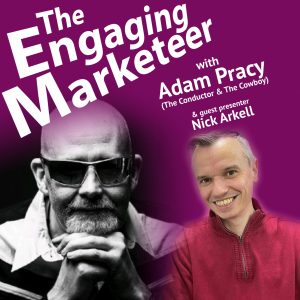
In this week’s episode of The Engaging Marketeer, Darren’s taking a week off, so you’ve got me, Nick Arkell.
I’ll be speaking to Adam Pracy. He’s been a friend of mine for a few years, but he first came to my attention over 25 years ago as a music producer. But there is so much more to the man.
He’s run an IT business. He’s also worked in the production of music for computer games. We’ll talk about what a cut-throat business that was, how he got into music, how he almost got into legal trouble, and, of course, we do need to ask him: why does he go around referring to himself as The Conductor and the Cowboy?
[01:15] Adam Pracy:
I think I always wanted to be a producer, not a pop star. I never wanted to be famous, but I always think it comes from watching Jean-Michel Jarre, Pet Shop Boys, Erasure, et cetera, and thinking, “I can do that.”
That’s kind of how I ended up here, through a convoluted route of video games, et cetera.
[01:37] Nick Arkell:
Well, let’s talk about your journey then. You became a musician eventually, and that was your profession after many, many years. But what led you to become what you are now?
[01:51] Adam Pracy:
I used to work in the video game industry. I used to work for a company called — well, I’ve worked for several of the big, well-known companies: EA, Eidos. Eidos are less well known today quite so much, but they were responsible for bringing Tomb Raider, et cetera, to market.
I had also worked for EA previously on a contract for a game called Space Hulk: Vengeance of the Blood Angels, which got amazing reviews and I guess catapulted me into — I don’t want to say the limelight — but catapulted me into other people’s interests.
The Space Hulk contract for EA, I was working freelance from home when I did that. Because I did such a good job of that, and it reviewed so well, I then got invited down to become part of the staff of this software development company, which at the time was called Tigon, which is a mixture of tiger and lion.
Fun fact: I believe Vin Diesel also had a company called Tigon for a short while.
[03:09] Nick Arkell:
Oh, okay. Yeah, company.
[03:12] Nick Arkell:
It’s quite a random company name, isn’t it, for two people to have the same exact… Was it spelled the same way?
[03:18] Adam Pracy:
Yeah. T-I-G-O-N. Tigon.
So, yeah, I moved down to Somerset to start that job. I’ve been here ever since. That was about, I don’t know, 15 years ago.
I worked for the software company for a few years, and then Eidos pulled the plug. This is not that unusual in video games. Basically, about one in 10 games that are started actually make it to completion, to get released.
[03:51] Nick Arkell:
Yeah. Yeah.
[03:53] Adam Pracy:
It’s that harsh. Because the suits think they know better. It’s one of those situations where all the suits at Eidos thought they knew better than the guys writing the video game down in Somerset.
Anyway, long story short, they pulled the funding — which was quite a lot of money — and so I needed a job. So I wrote Feeling This Way.
[04:17] Nick Arkell:
Oh, okay.
So you turned to music. See, a lot of musicians, they turn to music because it’s primarily a passion, right?
[04:30] Adam Pracy:
Agreed.
[04:31] Nick Arkell:
But not that many people can make it pay and make it into a living. Wow. I didn’t realise that’s how it happened for you. So you were out of a job?
[04:43] Adam Pracy:
Out of a job. Yep. Needed to cover the bills.
[04:46] Nick Arkell:
And you needed to cover the bills, and you turned to music to do that.
[04:50] Adam Pracy:
I had recently started going clubbing, had fallen in love with trance, and thought, “I could do that. Let’s give it a go.”
And I wrote Feeling This Way. First track.
[04:59] Nick Arkell:
Well, I think at some point during the podcast, I will give people a snippet of that track. Maybe round about now, maybe at the start, maybe the finish. I’m not sure yet. We’ll have to come back and edit it afterwards. We’ll see.
So that was a track that was your big hit from back then.
[05:17] Adam Pracy:
I didn’t expect it to be a big hit. Not at all. I just thought I’d got something quite good here.
Back then, as I think I’ve said in other interviews, I was just happy to get a track signed, never mind for it to become as popular and have Jules playing it literally every week.
So, yeah, that kind of changed my life.
[05:42] Nick Arkell:
We should probably explain, before I go any further with that story, who Jules is.
I’ll tell you now, Adam, when I’m in the office with Darren, the usual presenter of this podcast, and in fact everybody else I work with, if I turn to them and say Judge Jules, Dave Pearce — these names that people not just in trance music know, but people in dance music generally know, and people who grew up during a certain era would know — they don’t. I get lots of blank looks, and I’m thinking, “Wow, you don’t know who Judge Jules is.”
So why don’t you explain?
[06:22] Adam Pracy:
Jules O’Riordan, more commonly known as Judge Jules, was a Radio 1 DJ for many, many years. He used to do Friday nights and then Dave Pearce would do Sunday nights.
On a Friday night, if you were going out somewhere, that’s what you used to listen to before you were going out. It was like the weekend warm-up.
And he was my boss for several years. I was signed to him. He was my A&R guy. So when I would write a track, I would send it in, and Jules would either okay it or not.
[06:56] Nick Arkell:
Well, there’s another story that leads to that that I wanted to ask you about, actually, because I know a little bit about it, but I think we need to hear it in your own words.
So you made the track Feeling This Way, and that was your hit. But there was a lot more leading up to that, wasn’t there? Getting signed by a label to eventually…
[07:15] Adam Pracy:
Yeah. I had originally done a remix of Sonique’s It Feels So Good. I didn’t have any connection to her at all, or the label. And me, in my naivety at the time, just thought, “I’m going to remix that,” because I’d decided that’s what I wanted to do.
I didn’t realise she probably needed permission and I was probably stepping on people’s toes.
So I did this remix. I had a load of white labels pressed. They were sitting in my hall — 500 or 1,000 of them, I can’t remember how many — and I thought, “I’d better give the record label a ring. They might not be very happy with me.”
Turns out it’s a good job I did, because I gave the record label a ring, all sort of Johnny Big Bollocks, cock-sure of myself: “I’ve done this remix of Sonique and it’s brilliant. I’m going to put it out.”
And the voice at the other end of the phone came back, “No, I don’t think that’s a very good idea because you’ll be talking to our legal department very quickly.”
Turns out I was talking to Sam, Jules’s brother, Sam O’Riordan, and he was the label manager then. Looking back on it, it was an absolute bloody disaster.
I’d just rung up a label manager and said, “I’ve done a remix of your track. I think it’s great. I’m going to put it out. What are you going to do about it?”
Basically, I was threatened with legal action. But in defence of them, they did sort of say, “Jump on a train. Come up. We’ll meet you.”
And I just got the red-carpet treatment from there on. When I went up to the label offices, they were very excited about the remix. They were like, “This is great. Fantastic. Can you do something original?”
And I wrote Feeling.
[08:56] Nick Arkell:
I always like that story. I’ve never heard of anybody doing that, where you produced a remix of a track by a very well-known artist at the time, Sonique — absolute talent. She’s had lots of hits in the charts, of course. I’m sure some people watching will have heard of her.
You went out and did a remix, which a lot of people do, right? But you went out and did a completely unofficial remix.
[09:19] Adam Pracy:
Partway through the track, she drops down to almost an a cappella. So I just nicked that a cappella section and wrote the remix around it.
When I sent it into them, they loved it so much and they were like, “Do you want to do it officially?” I was like, “Yeah, go on then. Send me the parts.”
[09:36] Nick Arkell:
How many copies of this did you have pressed on white label before you asked them?
[09:42] Adam Pracy:
500 or 1,000. I can’t remember. I’d literally committed to it. I was like, “This is it. I’m going to do it and it’s all going to work.”
It was just a bit naive.
[09:55] Nick Arkell:
Naive is a good word.
[09:59] Adam Pracy:
Yeah, I’m being polite. Stupid is another.
[10:03] Nick Arkell:
It’s all right. Swearing is fine.
[10:08] Adam Pracy:
And I got lucky.
[10:09] Nick Arkell:
You did. You did get lucky because it could have gone the opposite way.
[10:12] Adam Pracy:
Yeah. I could have ended up in an awful lot of very serious trouble with the Serious Records legal team breathing down my neck. It didn’t pan out that way at all, and so I’m incredibly lucky that they loved what I did and wanted to embrace it.
[10:30] Nick Arkell:
And then you ended up making that track Feeling This Way, which anybody who likes dance music from that era, especially people who like trance music in particular, will know, because it’s so unique.
I bought it on CD back in the day and I was going to show you that CD today. I’ve never shown you, even as a friend, but I’ve lost it.
[10:53] Adam Pracy:
I’m sure I’ve got a promo kicking around somewhere I can send to you.
He says, looking down at his feet and going, “Look, look, look, look what I’m about to pull out here.”
Oh, look at that. A promo CD.
[11:03] Nick Arkell:
Yeah. Feeling This Way. Conductor & Cowboy.
[11:06] Adam Pracy:
There we go. That’s an official promo CD from the label, which I’ve hung on to because there aren’t very many of them.
[11:13] Nick Arkell:
Although my original CD is special to me because I bought it, what, 25 years ago? What year did it come out? Was it 2001?
[11:20] Adam Pracy:
2000. 28th of August.
[11:23] Nick Arkell:
So I’ve had that CD almost 26 years then. Hence, it’s gone missing somewhere. I’m not sure where.
I remember when I first heard that track, people, including maybe yourself, were saying they’d played the vinyl until they’d almost worn it out.
[11:43] Adam Pracy:
Well, the vinyl I only had over the past few years, you see, whereas the CD I’ve owned since new. And you can only wear them out if you scratch them, right?
[11:55] Nick Arkell:
Agreed. Yeah. Whereas vinyl doesn’t. If you keep playing them, every time you play it, it effectively takes a little bit of shine off.
[12:03] Adam Pracy:
Physical material, isn’t it?
[12:04] Nick Arkell:
Exactly. The stylus is coming into contact, whereas a laser doesn’t on a CD.
We’ll come back to music, I’m sure, but I wanted to ask you — because Darren, who’s the usual presenter of this podcast, he’s a bit of a nerd, to say the least.
[12:21] Adam Pracy:
What are you saying, Nick? It takes one to know one.
[12:24] Nick Arkell:
I certainly fit that category myself, as you know. But Darren, in particular, has a background in video games. He used to work for GAME before he started Engage Web.
So when I told him I was interviewing someone who’s a trance producer, he didn’t have much interest. But when I then said that you used to make PC game music, he had a lot more interest.
[12:48] Adam Pracy:
Yeah. Here’s Kryptonite.
[12:50] Nick Arkell:
So I was going to ask you: I know you spoke about the companies you worked for, and there was certainly one that I remember in there, Tigon. I’m sure Darren will probably know all of those company names, and I’m sure there are others watching.
[13:03] Adam Pracy:
The thing is, the developer name didn’t really get that well known. There was a logo on the box, but it was published by EA, which is an absolute global giant.
[13:17] Nick Arkell:
Massive name. Yeah.
So tell us some of the games that you made music for.
[13:27] Adam Pracy:
Wow. Okay. Going back a bit further, because I’m talking PC. Actually, I did some games for the Commodore Amiga before I did PC games.
There are a couple of games, two or three games out there called Turbo Trax, No Malone, Eco Phantoms. There are a few titles that kept me busy in my later teenage, early twenties.
Then I moved on to the big boys. They were kind of small, independent, indie games, but that was published on the Commodore Amiga. Then, yeah, I moved on to the big boys later on.
[14:14] Nick Arkell:
I know that at least one of the games you made music for is on YouTube, isn’t it? You sent me a link in the past, so I’ll get a link to that on YouTube when this podcast goes out, so people can sample some of your old work.
Have you ever thought of going back to doing that?
[14:36] Adam Pracy:
Every now and again, it crosses my mind. Maybe if I hadn’t done so well at being a proper musician — because people don’t think video game musicians… they didn’t when I was back then. Today, it’s probably a little bit different.
So every now and again, it crosses my mind.
[14:53] Nick Arkell:
With that in mind, the attitude that people have with music generally — I’ve had it as a fan of trance music in particular, which of course is an electronic music genre known as EDM these days. I find that people do look down at it sometimes and don’t understand it at all.
[15:18] Adam Pracy:
Yeah. I first encountered this growing up being a huge fan of Pet Shop Boys, and people at the time, my peers and my friends, would go, “Well, there’s no talent there. They just press a button.”
And you just think, “That’s not how it works.” They need to know how to use the computer in order to press the button. So there are kind of two skill sets there: you’ve got to be a great musician and then great at using a computer.
I totally agree, and I’m sure all the synth bands experienced this in the late eighties, early nineties: Pet Shop Boys, Erasure, Depeche Mode and stuff like that. There was an opinion back then: “Well, it’s not real music. The computer’s making it. You’re just pressing a button.”
I dearly wish to this day I could find the “make a hit” button on my keyboard, but it’s not there.
[16:06] Nick Arkell:
There’s always a demo button on keyboards, right?
I remember my first keyboard. It played — I’m sure it was a song by The Beatles or something. It wasn’t The Beatles. It was… Bananarama did a version of it.
[16:26] Adam Pracy:
“Baby, she’s got it.”
[16:28] Nick Arkell:
Yeah. Don’t know. Wasn’t that Venus?
[16:32] Adam Pracy:
I’m your Venus.
[16:34] Nick Arkell:
Who originally came out with Venus? It was The Animals, but in the late sixties, I think. Not that I should know that.
[16:41] Adam Pracy:
I believe Stock, Aitken and Waterman then covered it as a Bananarama song, and that’s probably the one you’re referring to.
[16:51] Nick Arkell:
Well, my keyboard version sounded like neither, really. It sounded like a nineties keyboard.
Right, so we’ve spoken about the games and that’s where you started with music, and then you moved on to be a musician.
How do you find the difference between — when you’re making music as a musician, I know you actually got into it because you needed a job, but it’s also a passion, right?
[17:26] Adam Pracy:
Yes. When I was writing video game music, that was more as a kind of passion that got me into that. Then, when that hit a brick wall and I was made redundant, it was a case of, “Well, I need to make some money. I’ve got to pay the bills. What do I know?”
I had recently started going out and clubbing, and Judge Jules on Friday nights, and this trance music was doing something for me. This is nice and euphoric. I can do this. Let’s have a punt at this.
I wasn’t thinking it was going to be really difficult, and yeah, I got lucky. My first attempt went big.
[18:08] Nick Arkell:
Yeah, it was a huge track. I remember looking at the CD — Conductor & Cowboy — and when I heard it, I thought, “This is very unique.” That’s hard to achieve in some ways with electronic music, when a lot of people are using the same synthesisers, the same production methods, and at the time you produced with a lot of different equipment, which had to be set certain ways. A lot of tracks started to sound the same.
Somehow you came up with something that was different. How did you manage that?
[18:44] Adam Pracy:
Truth be told, I wasn’t trying to come up with something different. I was trying to come up with something the same as everybody else, and missed by a little bit.
[18:57] Nick Arkell:
So it was a happy accident, really?
[19:00] Adam Pracy:
Kind of, yeah. I wasn’t specifically thinking, “I’m going to use a 303 for the arpeggio because no one’s done that before.” I wasn’t specifically thinking, “Let’s make this a male-female duet because no one’s ever done that before.”
It was just how it came naturally to me, and what the song sort of suggested it needed.
[19:20] Nick Arkell:
I suppose this can happen in any area of creativity, can’t it? Not just music. You can set out to be the same as other people but actually end up different by accident.
[19:32] Adam Pracy:
Yes. I was just trying to be the same as everybody else in that I was just trying to get signed.
Not only did I get signed, Jules loved the track and was playing it on Radio 1 consecutively for about 11 or 12 weeks. It was almost unheard of to get that kind of exposure.
[19:57] Nick Arkell:
How would you compare making your own track, where you’ve written it and produced it from the start — it’s all your own creation — compared to making music for computer games, where people have given you a spec, or indeed making remixes, where you’ve got somebody else’s tune to remix and you might have some kind of instructions and directions?
[20:22] Adam Pracy:
Remixes I find easier because you haven’t got to worry about the song side of things. That’s already done. Somebody else has written the song. It’s just my interpretation of it.
Whereas when you’re writing your own stuff, there’s a lot more flexibility because you’re not trying to follow the layout of somebody else’s song, the chord progression, et cetera.
You can’t suddenly change a chord, because that’s not allowed, but you can in your own song.
[20:59] Nick Arkell:
Right. So you haven’t got the creative challenge. You don’t have the creative block as much.
[21:03] Adam Pracy:
But in some ways that’s kind of nice, because that’s one less thing you have to worry about. You can just focus on producing the track really well.
You haven’t got to worry about, “Will that resolve properly? Does the lyric fit?” It’s all already there. It’s just your interpretation of that.
[21:21] Nick Arkell:
Of course. Do you think your nerdy side, dare I say, makes your approach to production more of a regimented or structured process, as opposed to some people probably just throwing all their creativity at a computer screen, or indeed at a synthesiser back in the day, and seeing what happens?
[21:47] Adam Pracy:
It teaches you to have structure to your workflow.
Instead of just sitting there and hitting keys and going, “Oh, that sounds good,” you’re at least starting with some sort of knowledge of, “I want this to be a dance track, so I’ll probably start with a kick drum.”
I don’t always start with a kick drum, but that’s a good example. Then you can write around those building blocks.
[22:17] Nick Arkell:
Let’s talk about something different you’ve done. I believe you’ve also worked in IT.
[22:24] Adam Pracy:
Yes, I have. I ran my own IT company for about a decade.
[22:31] Nick Arkell:
Let’s talk about that, because that’s a massive chunk of your professional life. You said you got into music to make money. Let’s be honest, we get into business to do the same.
[22:41] Adam Pracy:
Yeah. So when things started to go quiet after Feeling This Way, a few years after that, I started to think, “Well, this isn’t generating enough money now. I need to get a proper job.”
I couldn’t face working for somebody else. Once you’ve been your own boss, it’s very difficult to go back and work for somebody else, because you’re constantly thinking, “We’re doing that wrong.”
So I decided to start my own IT support company, where I’d provide service-level contracts. Back then, not everyone was computer literate like perhaps we all are today.
I was able to get contracts for the local shopping centre, the big shopping mall in Taunton. I provided their support for them. It was a 24-hour support contract, so they could call me any time, day or night, and I’d go down there and fix the problem.
[23:43] Nick Arkell:
And was it just you?
[23:45] Adam Pracy:
Yes.
[23:47] Nick Arkell:
Wow. Quite a commitment then.
[23:49] Adam Pracy:
Yes, I suppose so. Looking back on it, I wouldn’t do it again now, but in my late twenties that seemed quite appealing.
[23:57] Nick Arkell:
I suppose in your twenties, you feel invincible, don’t you? You’ve just passed university age, but you’re still young enough to push the limits a bit.
[24:07] Adam Pracy:
Yeah. I had tried to take over the world with music, and that had slowed to a point where I thought, “Well, let’s try and take over the world with support.”
So I started my own IT support company, ran it for about a decade, went round, got a few very lucrative contracts. The local shopping centre mall would have been one of them. I provided support to them for years and years.
[24:36] Nick Arkell:
The way you describe it, it sounds so easy. It’s almost like everything fell into place like your music did. Did you get lucky with that as well?
[24:44] Adam Pracy:
Well, you’ve got to know what you’re doing. You’ve got to convince somebody to part with that money — quite a lot of money — in a support contract, a service-level agreement.
So you’ve got to know your stuff. You can’t bluff it. Even if you were bluffing it, you’d get found out quite quickly at the first phone call you got for some support. If you can’t answer the question, you’re probably not getting the contract renewed.
Me being me, because I had some previous retail experience in my younger years — I worked for Dixons and Currys and Comet and places like that — I’d had that retail experience. So it was a case of putting my knowledge together with my ability to be quite professional and polite with people. That was a winning combination.
[25:44] Nick Arkell:
You mentioned Dixons and Currys there. What was your involvement with them then?
[25:48] Adam Pracy:
I first started working for Dixons when I was in my late teens, as most people do. I just needed a job.
Turns out I was quite good at it. What I mean by that is I find it very easy to sell things, because you don’t actually sell things. You just get enthusiastic. There’s nothing that sells a product quite like being excited.
If you can get excited about a TV or a hi-fi, that rubs off on the customer very quickly. They start buying into your belief system. Then, a little while later, you’ve relieved them of 500 quid, or one and a half grand, or whatever the telly was. If you keep doing that often enough, the company you work for quite likes you.
[26:37] Nick Arkell:
And you don’t necessarily need all the knowledge on those products to be able to get excited, I suppose.
[26:44] Adam Pracy:
No. It helps if you’ve got a bit of know-how about the product you’re selling, but if you can get enthusiastic in a genuine and sincere way, that is incredibly infectious.
[26:55] Nick Arkell:
Did any of this knowledge, and liking technology, and eventually running your own IT company — was there any education behind this? Any official qualifications?
[27:08] Adam Pracy:
No, I’m entirely self-taught. In fact, when I was at school, my computer science teacher essentially used to say, “Today we’re going to do this, this and this. Adam, just amuse yourself.”
[27:22] Nick Arkell:
Really?
[27:23] Adam Pracy:
Yeah. Basically. I knew more than he did, so what could he teach me? It was just like, “Don’t get in my way. Don’t disrupt the class and we’ll get on fine.”
[27:36] Nick Arkell:
Wow.
[27:37] Adam Pracy:
In fact, sometimes he would come and double-check things with me, double-check the answer before teaching the rest of the class.
[27:45] Nick Arkell:
You were the expert?
[27:47] Adam Pracy:
Yes. I was the geek, nerd, whatever you want to call me, that knew how to do it all from about age 10. Obviously, I’m talking slightly later, probably age 12, when I’m talking about school.
[28:07] Nick Arkell:
I ask what kind of computers you were using at that age, at the age of 10.
[28:15] Adam Pracy:
I was very similar to a lot of the nerds and geeks around at the time, who had home computers made available to them at semi-sensible prices. They were in reach of an awful lot of families.
I started with a Spectrum, went to a Commodore 64, then an Amiga, and then onto a PC. But I suppose at school it would have been more BBC Micros.
[28:46] Nick Arkell:
Yes. I’ve just seen your face light up because your school had them too.
[28:51] Adam Pracy:
They kind of got the educational contract, I think. An awful lot either had a BBC Micro or an Electron, which was like a cheap BBC, wasn’t it?
[29:02] Nick Arkell:
The thick floppy disks, didn’t they? The actual floppy disks.
[29:05] Adam Pracy:
Yeah, that’s right. They still used five-and-a-quarter-inch, or some of them even were eight-inch floppy disks.
[29:14] Nick Arkell:
Eight-inch? Do you know, I never got to use those.
[29:17] Adam Pracy:
I think you and I are probably more circa five-and-a-quarter. I can’t even remember. But yes, there was a forerunner to those.
As with all technology, it gets reduced in size and increased in capacity. So we came in probably the second level of that, which was the five-and-a-quarter-inch floppy disk. But there was a forerunner to that, the eight-inch or whatever it was.
[29:34] Nick Arkell:
You had me excited at Commodore 64, to be honest, before you even mentioned the BBC computers. I had one of those. In fact, I’ve still got one knocking about somewhere.
[29:42] Adam Pracy:
I’ve recently been thinking about buying another one, because I don’t know if you know this: a bunch of YouTubers and fans got together and bought the Commodore name. They’ve just put Commodore 64s back into production. You can buy a brand-new Commodore 64 now.
In 2026, I believe they’re going to be moving on to the Amiga. But at the moment, they’ve bought the Commodore name, the brand, got it all done legitimately. It’s all legal, all licensed, and they have just put them into production. Literally a couple of months ago, you could start to buy the first ones.
[30:21] Nick Arkell:
What a project. A passion, and the success of probably today’s promotional methods, social media, to something like that.
[30:29] Adam Pracy:
One hundred percent. It gives you that reach.
[30:34] Nick Arkell:
Let’s talk about that, because social media now is obviously one of the ways people promote online, on top of their own website and through everything we do at Engage Web.
How do you think that’s changed the way people promote themselves in the music industry, for instance?
[31:02] Adam Pracy:
It’s become a necessary evil. I’m not a particular fan of social media. I’m quite a shy person, and so the idea of putting myself out there to sell something is kind of my worst nightmare, really, because I’m quite shy and retiring.
But it’s a necessary evil. Once again, I don’t particularly like doing it, but I appear to be quite good at it.
I’ve tried very hard to avoid falling into this. There’s a certain group of people — and you all know who they are, but I’m not going to name them — that put out stuff on social media for the sake of it.
[31:45] Nick Arkell:
Yeah.
[31:46] Adam Pracy:
“Here’s an announcement about the announcement about the announcement.” Do you know what I mean? They’re sort of teasing it. I understand how we got there, but I didn’t want to be that person.
[32:01] Nick Arkell:
How genuine do you think it is when people post?
[32:05] Adam Pracy:
I think their desire to crack the algorithm and to make themselves more popular is genuine, but I believe we’ve created an awful lot of narcissists along the way.
[32:20] Nick Arkell:
It’s a pity, isn’t it? My personal opinion is that people can come across as narcissists on social media when actually in real life they’re not.
[32:29] Adam Pracy:
They’re not. But that’s the game they have to play.
[32:32] Nick Arkell:
It is a game, isn’t it?
[32:34] Adam Pracy:
It’s exactly that. Once you learn how to play the game, you can get quite good at it.
[32:40] Nick Arkell:
Indeed. Until one of the big platforms decides to change the algorithm, and you’ve got to work out what’s changed because suddenly, “I’m not getting as many hits as I used to get.”
[32:49] Adam Pracy:
Yeah. I don’t think all these people are narcissists, but that is the mould we are forcing people into. If you want to do well today, you have to.
A few years ago — it’s not so much now — there was this big thing about being authentic, and that is very, very true. Be authentic. Be yourself. Don’t try to be somebody else. But I also think that’s now less important today. We’ve kind of moved through the age of authenticity.
It’s still incredibly important. Never treat your audience like they’re stupid, because they’re not, and they will see through the inauthenticity very quickly.
Me being me, that didn’t really appeal to me. So I almost wanted to become a reaction against that. When I post some news, it’s because I’ve got some genuine bloody news. I’m not going to tease it with, “The announcement about the announcement about the announcement coming in three days.” Just make the bloody announcement in three days.
[34:07] Nick Arkell:
I’ll explain, for anybody who’s not in this industry: it’s a thing, isn’t it? People announcing an announcement now. We laugh at it.
[34:18] Adam Pracy:
I understand how we got there, because the game teaches you these rules: you need to post every day at the same time. “I haven’t got anything to post about. Oh, I’ve got a release coming up in three or four days’ time, or a week’s time. I’ll tease it.”
So you start teasing that. Do we really need that? Probably not.
[34:36] Nick Arkell:
I suppose that does come from the human psychology of teasing. There’s a reason that word exists, because teasing in certain situations is something else.
[34:51] Adam Pracy:
Yeah. But how much do we need to tease that? My choice is that I only need to tease it once, a week before the release or whatever. I don’t need to tease it every day.
We’ve all got someone in our feeds that does this, that over-posts, and it just becomes noise after a while. You just scroll past it.
[35:16] Nick Arkell:
Yeah.
[35:16] Adam Pracy:
I don’t want to be that. So I want to make sure when I post something, it’s interesting enough that people don’t scroll past it, and I haven’t abused that privilege of their eyeballs for that short amount of time as the post scrolls past.
Make it about something that’s genuinely interesting, be that a new release, a tour or whatever. Then don’t abuse that. Say your piece and off.
[35:48] Nick Arkell:
If there was ever a quote I’d take from you, a bit of advice, that’s the one. Brilliant.
Because people become oversaturated, or bored, however you want to look at it, very quickly.
[36:03] Adam Pracy:
Yeah. Humans have a very small attention span, especially in this world we’ve created of social media. We’ve almost created an entire generation of people that have about a 15-second attention span. If you haven’t hooked them in those 10 or 15 seconds, that’s it. They’ve scrolled on.
So I understand how it happens, but I just never wanted to be an artist like that.
[36:28] Nick Arkell:
I was going to joke about that and pretend I’m not listening to you, but that would have been an obvious joke.
I was watching something yesterday. I was at my mum’s and it was Ben Fogle. He was visiting China and he discovered this new type of TV soap which is filmed in vertical format for platforms like TikTok.
[36:52] Adam Pracy:
Okay, pet hate. TVs are 16:9. I appreciate the younger generation all hold their phones vertically. I’m not one of those people.
When I take a picture, there’s a reason you can rotate it. It’s so that it fits the TV you’ve got. I’ve got a nice big telly. Why do I want to just use a tiny little slither in the middle of it?
[37:15] Nick Arkell:
Okay, you’re a techie person. I’m a techie person. What do we think of the future, though? Do we think it could go as far as TVs becoming portrait?
[37:27] Adam Pracy:
It already has. You can buy some screens now, high-end screens from Samsung, that actually rotate. Quite a lot of computer monitors do now.
Quite a lot of youngsters will have a screen next to them, because it’s become popular to have dual screens, sometimes triple screens. In my day, we would have dual or triple screens, but they would always be in widescreen format.
Nowadays, the kids have decided, “I’m going to have Discord, my chat application, on that vertically.”
Do I ever think TV will? Probably not ever, because of the natural viewing format that we’re all used to. I can’t ever see us going to watch a movie in vertical. I think TV is going to stay as widescreen 16:9.
There’s too much that’s gone into and been invested into that format for it to suddenly change. Also, the only reason we hold our phones vertically is because that’s the way we carry them. We don’t watch TVs vertically because they look stupid in living rooms.
[38:42] Nick Arkell:
I agree with you on your opinion. I just wonder, with the way things have rapidly changed so much with technology — you look at how technology has evolved so quickly — are we being naive about it, maybe, in assuming that can’t change?
[39:00] Adam Pracy:
I suppose films are all in horizontal. Widescreen. Do I ever think the movie industry, Hollywood, is ever going to move to 9:16? No, I don’t.
Because then they’d have to rebuild cinemas, and that’s just never going to happen.
[39:17] Nick Arkell:
Or they just shut altogether.
[39:25] Adam Pracy:
Yeah. Well, we’re probably fairly close to that already, sadly.
[39:33] Nick Arkell:
One thing that’s not died yet, and I hope never will, is the genre of trance music.
We spoke about it quite early on in this episode of The Engaging Marketeer, because that is ultimately how I know you. We met maybe three years ago, and this is all through me streaming online through my Twitch channel.
[39:56] Adam Pracy:
Yeah. Started to get a bit of promo in there, and we got chatting and became friends.
I keep coming back to your stream because you do something that a lot of people don’t. Maybe it’s because you’ve got experience in the commercial radio industry, maybe not, I don’t know, but you are very good at the chat. A lot of DJs just don’t do the chat. I understand the reasons why, but you bring a very commercial radio flavour to your stream, and I like that. That’s why I keep coming back.
[40:36] Nick Arkell:
It probably is my radio background, as you know, and what I do away from being a web developer here.
Well, thank you, firstly. I know you enjoy my streams. I love you being there.
[40:55] Adam Pracy:
Apologies for not coming along recently.
[40:58] Nick Arkell:
It’s okay. People have lives. I shed a little tear when I don’t see you there in the chat, but a few tunes later, I’m okay.
I was going to talk to you about something. I remember quite early on, chatting and getting to know each other, before we really knew each other that well, you explained this to me — because I’ve had friends over the years who I would just call shy.
[41:35] Adam Pracy:
No, I’m incredibly introverted. It does get described as shy or whatever, but I’m just introverted. I find a social occasion quite a lot of effort, quite tiring, and so I’m just looking forward to that social occasion being over so I can get back to my space, my house, my lounge, whatever it happens to be, where I can recharge my batteries.
Extroverts are the opposite. They thrive on going out and seeing people, and they draw energy from that. Then they have to go home to their empty house afterwards, whereas I quite like that.
[42:20] Nick Arkell:
Do you think some people can switch between? Because I feel like I’m one or the other depending on what day it is.
[42:28] Adam Pracy:
Yes. It’s possible for me to switch between. When I know I’ve got an engagement coming up where I’ve got to be extroverted, then I can turn it on when I need to.
But I don’t like to be like that all of the time. I am quite shy and quiet, or introverted. I have no problem with my own company.
Lots of people don’t like their own company, and the idea of spending several days alone with themselves would terrify them. Whereas the idea of spending several days alone with other people terrifies me. I’d much rather be alone.
[43:04] Nick Arkell:
Do you think this is common in the music industry?
[43:09] Adam Pracy:
That’s a good question. Just based on the people I know, it constantly surprises me how many other producers are introverted.
So yes, I do think it’s quite common. I don’t know whether it’s something to do with our personalities or what. I don’t know what it is to do with, but yes, there are an awful lot of producers that are quite introverted and would prefer not to have to do the social thing at all.
[43:46] Nick Arkell:
There’s another producer, a mutual friend of ours, who I remember when I first got speaking to him, he was telling me that a lot of his days as a DJ…
[43:56] Adam Pracy:
Are we talking about Stuart?
[44:01] Nick Arkell:
We are talking about Stuart, yeah. I remember him telling me that his early days of being a DJ, alongside being a music producer, he would go to a gig, perform his duties as a DJ and as an artist, and then he’d go home.
I can completely understand that. If I was in his situation, I probably would have done exactly the same thing. But I probably also would have questioned myself: “This is what I want to do. Am I supposed to be doing that? Am I supposed to stick around afterwards and schmooze?”
Do you think it comes from… I should point out here to anybody who’s watching and not really understanding the electronic music industry: a lot of the people who succeed do two completely different jobs in one. You’ve got your production side, which in itself splits into being a musician as well, and then you’ve got the performance side, which is being a DJ.
[45:05] Adam Pracy:
The production side is all about being a perfectionist. It drives my wife up the wall. I’m such a perfectionist.
If I’m going to do something, it’s got to be perfect, otherwise why am I bothering to do it? Somebody else could make a hash of it. I’ll let them do it. If I’m going to do it, I’ll do it properly and to the best of my ability.
[45:24] Nick Arkell:
Do you think you put more time than you should into it?
[45:28] Adam Pracy:
Yeah, probably. But that’s what separates the men from the boys, I suppose. The people who find success are the ones who’ve invested that time in their production skills.
Being a producer is all about removing what you don’t want. A lot of people think it’s something else, but my entire job, really, apart from making up the notes and stuff, is about removing stuff that shouldn’t be there.
That’s how you produce a track. That’s how you EQ a track. You’re removing all of the unwanted noise.
[46:08] Nick Arkell:
That’s an interesting way of doing things. I don’t know if that would apply to many other professions, really.
[46:15] Adam Pracy:
I completely agree. So if I’m sitting watching telly of an evening and I hear a thump, or I hear a car door half a mile up the road slam, my brain is tuned to find things that shouldn’t be there.
I’ll hear a car door half a mile up the road slam and my brain will be like, “What was that?” because it shouldn’t have been there. I’m very good at finding the thing that shouldn’t be there, whether that’s a frequency while I’m EQing a track, or it’s just some noisy neighbours outside. My brain is attuned to find the thing that shouldn’t be there and remove it.
[46:53] Nick Arkell:
It’s an interesting angle. I’d never seen production that way, actually.
[47:01] Adam Pracy:
Essentially, that’s what we’re doing. Many people won’t necessarily admit that. They view it as all about putting stuff in. I view it from the opposite angle. It’s all about taking stuff out and just leaving the good stuff.
Most synth patches, when you find an instrument or whatever, sound lovely. But what’s it going to sound like with everything else going on?
When you introduce that instrument into your mix, suddenly it sounds different, and so you need to remove the harsh frequencies that make it stand out and don’t make it sound pleasant and attractive.
[47:44] Nick Arkell:
With all that perfectionist attitude in mind, and all that time you’re spending, do you think with yourself and producers generally, who are probably putting the same amount of time into these tracks as you are, that leads to being an introvert?
[48:00] Adam Pracy:
Well, it’s a very lonely occupation because a lot of the time you are sat on your own. But don’t start feeling sorry for me, because that is by choice and I quite like that.
I often work through the night because there are no phone calls, no interruptions, and I can just crack on. I get so much more done at night than I do during the day, when there’s a phone call or a knock at the door or whatever to distract me.
If I just get in my zone in the studio from 11 at night until 5 or 6 in the morning, there are no interruptions. You can get so much done.
[48:36] Nick Arkell:
Yeah, I can completely agree with that. I’ve been the same myself. Although when you’re doing a job such as a web developer for someone like Engage Web, I have to be there nine till five.
[48:53] Adam Pracy:
I appreciate that you have a nine-to-five job, but do you actually have to be there, or could you do it at one in the morning?
[48:59] Nick Arkell:
I personally could do it at one in the morning on a personal level. But as a company, obviously you’ve got clients and stuff that aren’t going to be around at one in the morning.
[49:14] Adam Pracy:
But you can talk to them during the day and then structure your day so that you start work at one in the morning, midnight-ish, whatever, when it’s quietened down.
[49:23] Nick Arkell:
You could be reshaping the way people work in the marketing industry.
Let’s talk about marketing then, because you’ve done several things. You worked in Dixons and Currys, that’s where you started. I’m sure you encountered the way they marketed as retailers.
But you’ve also done your IT business, and of course you’ve been a musician and worked in gaming. What are the differences in the way things are marketed in those different industries you’ve worked in?
[50:03] Adam Pracy:
Working for Dixons or Currys is a very large organisation, and back when I was doing it they would have massive advertising budgets that you would see on television, in the newspapers, and stuff like that.
Today, we don’t have that. It’s very much more grassroots. You kind of have to do it yourself. It’d be lovely to have a huge marketing budget, but often we don’t get that. So you have to grassroots it in some way.
I guess that’s what social media is. That’s your way of advertising things, right?
Coming back to the point we were making earlier, I think if you over-advertise something, you can actually harm it.
[50:49] Nick Arkell:
Yeah. Make people sick of you.
I sometimes wonder if I do that on my social media, but I’m not the expert in social media. I’m the expert in building websites.
[51:00] Adam Pracy:
I think the fact that you manage to bring in the size of audience that you do, week in, week out, is testament to you not overdoing it. It’s a challenge to get that balance. You get it just about right.
[51:19] Nick Arkell:
Thank you. You could probably hear the doubt in my mind quite a lot when we chat.
I’m known to be someone who can be very self-deprecating. We spoke about Stuart, actually, our mutual friend in trance, and he once said to me a year or two ago, “Nick, stop self-deprecating.”
For me, that comes down to the psychology. I sort of understand why you do it. If you say the negative comment yourself before anybody else gets in there, you’ve kind of disabled that angle of attack, haven’t you?
[51:56] Adam Pracy:
Because you’ve said it yourself.
[51:58] Nick Arkell:
Yeah. I suppose that’s the immediate effect.
But what I was going to ask you really is, as a musician in particular and as a creative artist, how do you find the psychology of not just being in the music industry — because that’s been the case for a long time — but also social media? Because both those things do have an effect on people.
[52:21] Adam Pracy:
Firstly, when it comes to the work, I prefer to let the work speak for itself.
You’ll very rarely hear me bigging up one of my tracks or saying, “I’ve written this banger,” or whatever. Just let the work speak for itself. People will work out if it’s a banger or not quite quickly. You don’t need to blow that trumpet.
At least, that’s how I feel anyway. I’m sure there are other artists out there who feel completely differently, but that’s what’s worked for me. Less is more.
[52:54] Nick Arkell:
I suppose the big tunes — Michael Jackson, for instance, the big songs by him and all the other hugely successful artists in the world — their music didn’t become successful because of them promoting it.
[53:11] Adam Pracy:
Exactly. Word of mouth. Someone bought it, heard it on a radio station and played it to a friend. That’s grassroots advertising, and advertising you haven’t had to pay for.
[53:26] Nick Arkell:
How do you feel about the whole popularity thing? This has been amplified by social media, hasn’t it? Being the popular person.
[53:39] Adam Pracy:
Yeah. I think years ago I was much more bothered about it. Today, I’m not bothered about it at all.
Maybe that’s because I’ve found my place and I’ve got my fan base, so maybe I don’t stress about it too much.
[53:53] Nick Arkell:
You’ve got your happy place.
[53:57] Adam Pracy:
Yeah. I post about something when there is something to post about. I don’t abuse the eyeballs or the ears or whatever.
There comes a point where “happy place” is a sweet spot. There’s a nice position that I feel like I’ve carved myself out where I don’t have to post something every day.
[54:27] Nick Arkell:
What would you say to younger people who are producing music? They’ve obviously got better tools to do it these days, which is helpful to them, but at the same time they’ve got a bigger challenge of going up against more people trying to do it.
[54:54] Adam Pracy:
I agree with what you just said there. Also, there’s been a tendency in the last decade, or slightly more, where young, up-and-coming talent feels like they have to do it all themselves. You don’t have to do it all yourself.
[55:17] Nick Arkell:
What — the music, the production?
[55:20] Adam Pracy:
Yeah. Everything: the music, the production, the artwork, the promotion. They feel like they have to do it all themselves, and you don’t have to do it all yourself.
[55:30] Nick Arkell:
So delegation?
[55:32] Adam Pracy:
Well, yeah, to an extent. I appreciate a lot of people don’t necessarily want to delegate because then they’ve lost control.
But quality, not quantity. Quality, honestly, is what I would say.
Make the work amazing, the best that you can make it. Rather than pumping out 10 tracks, just do one amazing track. That’ll get you much further.
[56:05] Nick Arkell:
Good advice.
[56:06] Adam Pracy:
Today there has become a tendency for people to do the opposite: quantity, not quality. They’re banging out a track every week or every few days or whatever, and it’s a bit like, “Is that special, or is it just another track?”
I’d rather spend two or three months on a track that is perfect, that I am properly proud of, than bang out half a dozen tracks in the same time. Yeah, they’re pretty good. Yeah, they’re all right.
[56:40] Adam Pracy:
But that’s just me being a perfectionist, I suppose.
[56:44] Nick Arkell:
It’s probably not just you though, is it?
[56:47] Adam Pracy:
But that would be my advice: don’t cut corners, don’t rush. Quality, not quantity.
[56:56] Nick Arkell:
I suppose with a fast-moving world, the way things are, and short attention spans, it’s probably tempting to produce lots of mediocre material as opposed to a small amount of quality.
[57:08] Adam Pracy:
Yes. It’s natural also that once you’ve had some success, you think, “Well, that worked well. I’ll just repeat that. Rinse and repeat.”
The more I can rinse and repeat, the more I’m going to make.
That’s a slippery slope, and you don’t necessarily want to go down there, because actually it can be quite counterproductive and work against you, putting too much stuff out, because you’re oversaturating your market, your fans.
[57:32] Nick Arkell:
Yeah. I mean, you’ve said several times now, haven’t you, that if you put too much out there, it becomes noise.
[57:40] Adam Pracy:
Whereas, if I just put out — I mean, this would horrify some other artists — but I would prefer to put out three or four very good quality tracks a year that I’ve crafted and honed to perfection, rather than just banging out one a week, 50 a year, whatever.
Also, I’m very good at realising that while I might be able to do that for a few weeks, I can’t sustain that. So I’ve made a rod for my own back then, haven’t I?
It’s a bit like YouTube or any of the social platforms. Consistency is key. Make a routine and stick to it, whatever that routine might be. But I would suggest to you that once a week is plenty, because you’ve got to maintain that for effectively forever now.
[58:29] Nick Arkell:
Yeah. Someone else said that to me recently, actually, with TikTok. They got loads of followers on their videos, with thousands and thousands of views, but he said to me, “The minute you stop posting, you lose it.”
[58:46] Adam Pracy:
You lose it. Yeah. Whereas I don’t post that often, and so there’s much less for me to lose.
[58:55] Nick Arkell:
I’ve got to admit, when I see someone post who’s not posted in a while on social media — whether it’s a personal thing or a professional thing, like yourself about your music — I do notice it.
[59:04] Adam Pracy:
Exactly my point. Thank you for proving my point.
I don’t have to fight for eyeballs anymore, or headspace from people. As you’ve just said in your own words, if I put a post up now and I haven’t posted in months, I know the algorithm is going to show that post to quite a lot of people.
Not just anybody — quite a lot of relevant people. So I’m going to get quite a lot of engagement because it’s good quality, it’s interesting, and I haven’t spammed you.
All of these things play into how much attention a person gives to something like that. As you’ve just said, if whoever it might be hasn’t posted in a while and the algorithm surfaces that to you, you think, “Oh, I haven’t seen that person post for a while. I’ll pay attention to that.”
[59:57] Nick Arkell:
It’s not something I’d really thought about, but the minute you said it, I thought, “Wait a second. Yeah.”
[1:00:08] Adam Pracy:
Also, I haven’t made a rod for my own back where I have to feel like I have to post something every day or every week.
I’m very old school in my approach. I’ll shout about something when I’ve got something to shout about.
[1:00:25] Nick Arkell:
It’s a good approach.
We’re almost at the end of our time, really. I think we’ve gone over slightly.
[1:00:34] Adam Pracy:
I thought that might happen.
[1:00:36] Nick Arkell:
Well, we like to have a chat, don’t we?
We’re speaking about new artists, and there was something I did want to ask you about. I know that you’re involved in a music label as well. Obviously, you’ve written music for labels before. You’ve remixed. You spoke about Serious Records back in the day. You released your big track, Feeling This Way, and that was Judge Jules’s brother, right?
[1:01:01] Adam Pracy:
Yes, Sam.
[1:01:03] Nick Arkell:
But now you’re involved in a relatively new label. Tell me about that.
[1:01:09] Adam Pracy:
Well, it’s been going 18 months, a couple of years now. Simon, Lost Witness, another very good friend of mine, wanted to start a label and asked me if I wanted to be involved.
I said, “Yeah, why not? Come on.”
He asked me, I guess because of my history and credibility and knowledge, if I would head up his A&R team for him, which I do.
It’s very interesting. It’s very rewarding because it’s nice to give back to the industry and give somebody else that break that I got.
[1:01:48] Nick Arkell:
So you’re paying it forward, really.
[1:01:50] Adam Pracy:
Yeah, exactly that. It’s very rewarding. When you get a bit older, the rewarding stuff is why you do it.
[1:01:57] Nick Arkell:
Well, I’ll stick a link to the label as well under the interview so people can have a look at that and check out some new music.
That’s pretty much everything we have to speak about today. Before we stop, though, let us know how people can get in touch with you, ask about your music or anything else really. What’s the best way to do that? It could be your website.
[1:02:28] Adam Pracy:
Conductor & Cowboy has a website. We are on all the social platforms. I’m not difficult to find.
Just reach out. Just look for Conductor & Cowboy.
[1:02:35] Nick Arkell:
And you know what? I wouldn’t usually do this, but one more question before we go. What we’ve not explained is the name Conductor & Cowboy.
[1:02:51] Adam Pracy:
So many years ago, when I used to go clubbing, I got myself a bit of a reputation for conducting the breakdowns and builds.
My production partner at the time, who’s also the male vocal on Feeling This Way, used to like wearing a cowboy hat. So very quickly, the name stuck: Conductor & Cowboy.
It sounded catchy and sounded a bit different. It sounded a bit like a Pet Shop Boys lyric, which appealed to me. So I thought, “Yeah, that’s a good name.”
Every single day I think, “What a great name that is,” because it stands out. It’s not “Neutron” — sorry if you are called Neutron, I haven’t singled you out on purpose — but do you know what I mean? It’s a name that stands out and is quite catchy.
[1:03:43] Nick Arkell:
Brilliant. Well, thank you for joining me today. It’s been an absolute pleasure, Adam, to speak to you as a friend and as a professional, my fellow trance enthusiast.
[1:03:58] Adam Pracy:
You’re welcome. I’ve enjoyed it. It’s been nice to chat to you, Nick.