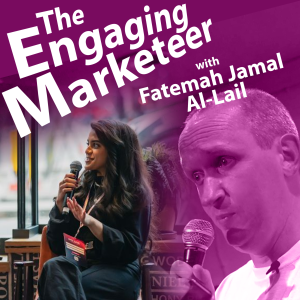
[00:52] Darren: On this week’s episode of The Engaging Marketeer, I am speaking with Fatemah Jamal Al-Lail.
Fatemah works in CRO — conversion rate optimisation — personalisation and SEO for an e-commerce brand in the beauty industry.
Fatemah came from working as a buyer for beauty into merchandising websites for beauty, and now runs quite a lot of the marketing for a beauty brand.
So I’ll be asking Fatemah how she got into that, what she sees as being different about the beauty industry compared with other sectors and, spoiler alert, we’re going to go into a few conspiracy theories about personalisation on websites.
It’s all very scary!
So let’s find out a little bit more about Fatemah.
[01:35] Fatemah: It’s my first ever podcast. I’m excited.
[01:40] Darren: Your first ever? You’ve done a lot of public speaking, though, and it’s your first podcast? That’s surprising.
[01:46] Fatemah: Yeah. I have done quite a lot of public speaking, especially this year, but this is my first podcast. So I’m excited to hear my podcast voice, I guess.
[01:55] Darren: Your podcast voice? I suppose, yes, because when you’re doing public speaking, you don’t hear yourself back.
[02:01] Fatemah: No, you don’t. And I don’t know if that’s sometimes a blessing.
[02:06] Darren: Yeah. You just hope it’s gone okay, and they’ve told you it was all right.
But with this one, you are going to be able to hear it. You’re going to be able to see it. So you’ll know how good you were — or not, presumably.
So, you’re obviously working in digital marketing. You’re working in SEO and conversion rate optimisation.
That is traditionally still quite a heavily male-dominated role. What brought you into that industry in the first place?
[02:37] Fatemah: That’s a very good question. I kind of just fell into it.
My background before that was in beauty merchandising. I worked for a bit as an assistant buyer for a luxury brand conglomerate in Saudi, and then I started working at Birchbox as a merchandiser for their beauty products.
But the role reported into an e-commerce manager, and then the company globalised. They made a lot of redundancies, unfortunately. This was a very long time ago and the company is no longer operating, so that’s fine.
I then had to manage the e-commerce for the UK and Spanish markets, which was very interesting. So I kind of fell into e-commerce and the world of e-commerce that way.
I never thought I would be interested in that. I always thought I’d be more interested in merchandising.
Buying was more exciting to me because of all the travel and all the exciting places it takes you. Then I enjoyed merchandising because of Excel — I just love Excel.
But then I fell into the e-commerce world, and I thought, “Wow, this incorporates both a very analytical way of thinking and using your own creativity.”
It’s such an exciting space to be in, especially now. Every year it becomes more exciting because of all the innovations in the industry.
There’s a lot of exciting tech out there, and I think sometimes when you’re working for smaller brands, you’re more exposed to all the new technology that’s available.
Especially if you don’t have a huge in-house development team, you’re experiencing first-hand and learning about what is out there, all the third-party apps, and obviously AI is now changing the whole game.
[04:50] Darren: Yeah. When you’re in a smaller company like that, it’s a bit more tight-knit and your responsibilities are a bit wider than they would be if you were with a huge brand.
If you were just doing merchandising on a website, or just doing content on a website, that would be your little bit and you wouldn’t really move out of it.
So you had to get involved with a lot of different aspects of the e-commerce website.
If you come from a buying background, though, was there any point where you were looking at what had been bought to be merchandised on the website and thinking, “Do you know what? I wouldn’t have done that.”
[05:26] Fatemah: Yeah. I would say that’s kind of my advantage, because I understand how the buying and merchandising teams think.
I don’t necessarily think, “Why would they buy that?” because obviously they have their own ways of analysing customer behaviour.
I also feel like the best way forward for brands is to make those kinds of decisions together rather than in silos.
We’re obviously all working towards the same holistic reason, which is giving the customer the best experience.
Having those areas working in silos, I don’t think that works for a brand, especially moving forward when everything is very connected.
Merchandising on the website, like you mentioned, is very connected to paid activity.
[06:35] Darren: In terms of merchandising on the website, to give you some background, I used to work for GAME.
Fatemah: Oh yes, I remember.
Darren: I was the web designer at GAME. So I did a similar thing to what you did, but I wasn’t the one merchandising the site.
We had merchandising meetings where we saw the schedule every week. We’d know what games were coming out the following week.
We knew which games we were going to put at the top of the PlayStation 2 category, which ones were going to the top of the Xbox category, which ones were going to have the featured graphics and which ones were going to appear in the charts.
Because the charts weren’t real. They were fake!
[07:14] Fatemah: You’re spilling industry secrets here! Are the bestsellers actually bestsellers?
[07:18] Darren: Oh yeah. The “bestsellers” every week were the ones we wanted to get rid of.
So there were a lot of decisions made as a group about what gets promoted and when.
But what part of merchandising an e-commerce website excited you the most, coming from the buying perspective? What was it that you really liked about merchandising a website?
[07:46] Fatemah: What I found very interesting was the data you get. You can almost read people’s minds.
That’s very difficult to get in more traditional bricks-and-mortar stores.
Now there is technology available to get more omnichannel data that’s connected, especially if you work with a platform that has both POS and an online platform, but I would say it’s still tricky.
Whereas online, you get heat maps with things such as Hotjar or Microsoft Clarity, and you can literally see videos of people and their browsing habits.
It’s just fascinating because everyone is very different.
I don’t think you can get that kind of data anywhere else in a different environment.
So, yeah, it’s the data. Reading the consumer’s mind.
I’ve always been really obsessed with consumer behaviour. It was my favourite business subject when I was studying marketing.
It’s really cool to see that we have access to that nowadays.
You get a lot of data, and sometimes you can get lost in it if you’re not analysing it or gaining insights from it in the right way. But there are lots of tools now that are very sophisticated at doing that.
[09:23] Darren: You mentioned it’s one of your favourite aspects within marketing. Of course, there’s a big crossover with psychology there as well.
What makes people buy?
What makes them buy this product over that product? Or what makes them choose this website over that website?
Again, when I was at GAME, we were Electronics Boutique and they bought GAME, so we were running the two brands side by side.
You probably don’t remember Electronics Boutique. It was on the high street a long time ago.
We were running the two brands side by side with the exact same products and exact same descriptions — which would be a Google issue nowadays, but wasn’t so much back then.
There was one differentiator between the two websites.
One had free delivery but was effectively £2 more expensive. With the other one, you paid £2 less and then paid for the delivery.
People loved the free delivery.
They didn’t mind paying more for “free” delivery. It was a massive psychological change.
So what sort of things did you see when you first got into this that you were able to look at and change that had a big impact on the success of a website?
[10:36] Fatemah: It’s fascinating and, like you said, it’s deep psychology.
I was lucky enough — well, I guess it’s part of the job — to do some A/B testing, and it’s very interesting to get to see that aspect of it.
Something as simple as changing the colour of a discount can make a difference.
Instead of a discounted price being red, changing it to another colour.
This actually happened accidentally in one of my previous roles, where the font colour was accidentally changed to green.
But it worked really well for that sale campaign.
I think, for people, it was simply because it was something they weren’t used to seeing.
It increased conversion even though nothing had changed in terms of the regular discounting.
It was just something very deeply psychological that changed for customers.
I think that kind of thing is fascinating.
When you’re doing A/B testing, you get to test very different hypotheses, and it’s always good to test the craziest ideas because you don’t actually know.
Things like that — you wouldn’t know until you tried them.
[11:59] Darren: So the fact that the colour was changed, it was just something they weren’t used to seeing, so it drew people’s attention and got them curious as to what it was?
Fatemah: Yeah.
[12:10] Darren: So maybe every once in a while just do that — just do something strange and see!
[Laughter]
It’s a pattern interrupt.
I did a talk about this a while back.
If you’re at a networking group and everybody stands up and starts exactly the same way — “Hi, my name’s Darren. My company is Engage Web” — you blend in.
But if you stand up and say something completely off the cuff that no one expects you to say, immediately people start to listen to you.
It’s the same online.
If you try to do something different that’s going to make people think, “What was that?” it’s going to draw attention and get more of a response.
Whereas if something blends in, we get ad blindness.
[12:51] Fatemah: Yeah, we do.
I think you mentioned something similar to that earlier.
Customers get bombarded by emails every day — probably at least 50 emails a day from different brands they subscribe to.
Especially now, customers look for that unique thing that connects them to the brand.
Companies need to work more on that aspect, on that human connection, engaging in a deeper way with customers in order to stand out.
[13:37] Darren: Yeah, because you’re right. If you get emails that are very, very similar, people are just going to ignore them.
There’s a whole science behind open rates in emails, tweaking subject lines and getting it to trigger the right response in somebody so that they open the email.
But, as you mentioned, you need a lot of data to make that work.
You need to be working on a website with a lot of traffic, or you need to be working with a customer database with a lot of data, so you can make those informed decisions.
How easy do you think it is for somebody with a smaller website to know what works and what doesn’t work?
[14:18] Fatemah: I guess the easiest indicator is sales and conversion rates because that gives you a straight answer.
You got this number of people in. Did they buy or did they not buy?
That’s a clear indicator.
Looking at the customer journey and where they’re dropping off gives you a key indicator of where the problem points are.
There are lots of free tools out there as well.
I’ve used Microsoft Clarity in the past, which is a free tool from Microsoft where you get browsing data and deeper analysis of how customers are behaving, including heat maps.
There are lots of tools out there that can help.
[15:13] Darren: And you think it’s important to use things like that so you can understand your customer journey — what it is they’re looking for and, as you said, where they’re dropping off?
If you’re spending money on Google Ads and somebody is coming through to a website, but you’re losing even one or two per cent of the sales you would otherwise be getting, then the more money you spend on the ads, the more money you’re losing and the lower the profit you’re going to make.
So people really need to get into that data and use it.
I think a lot of businesses aren’t actually doing that, though.
[15:52] Fatemah: Yeah, it is interesting.
Even now, there are tools like ChatGPT.
You can prompt it well and ask it to thoroughly analyse your website.
Give it a few of your competitors and ask how your site measures up to them, or how it measures up to a website you look up to or really appreciate.
It doesn’t really need to be in the same industry.
If I’m looking at updating a feature, I sometimes look at really random websites that aren’t in fashion and aren’t in beauty, just to see what they’re offering their customers that’s different.
Then you can find a way to translate that into your own industry.
Otherwise, all the websites are just going to look the same, and that’s not great.
[16:50] Darren: I think that’s the key.
There are a lot of websites that do look very similar and, because they look similar, they blend into each other and nothing really stands out.
But by the same token — and I’m going to go back to what we did at GAME as well, because this was about 25 years ago — they tried to make the GAME website different to the Electronics Boutique website.
They made changes for the sake of making changes.
The whole navigation was moved to the opposite side. It was on the right-hand side rather than the left, and there was a sub-navigation across the top.
That meant people using the site found it difficult to navigate.
[17:32] Fatemah: Yeah, because you’re not used to seeing navigation on the right.
I guess 25 years ago that was different. Nowadays, with mobile, the majority of the population is right-handed, and if they’re scrolling—
[17:49] Darren: This is true, because you’ll have the burger menu now or a pop-up menu, so the navigation is completely different.
I was going to ask you about the beauty industry now, because I think this is important.
How does the beauty industry differ from other industries?
Obviously, people who buy video games tend to be nerdy, technical people. I’m generalising — I shouldn’t do that, but I’m generalising!
Whereas the beauty industry has a very different type of clientele looking at a website.
What sort of fundamental differences would you expect to see from a beauty website as opposed to a gadget website or a technical website?
Or are there any? Am I looking too much into it?
[18:32] Fatemah: I think there is a huge difference, especially when it comes to beauty, because these are products that you are using on your skin.
It’s very important for the customer to understand what ingredients are in the product.
Nowadays, customers are very informed.
They go onto a website knowing what they’re looking for and what ingredients they’re looking for. They’ve already done their research.
Of course, there are also things such as allergies. Has it been tested? Is it dermatologically approved?
[19:13] Darren: Easy for you to say!
[Laughter]
[19:18] Fatemah: I know!
I think that’s one of the biggest challenges for beauty companies: making sure that information is there and clear within the first fold.
Customers aren’t necessarily going to scroll.
But it’s also really cool, because you get a lot of extra data on your customers — their skin types, their skin concerns or, when it comes to beauty, what colours people enjoy wearing.
I would say that’s one of the biggest differences.
[19:57] Darren: How much does trust come into it?
As you say, it’s something you’re putting on your skin and, if it’s not what it claims to be, somebody could have a reaction to it. In some cases they could have a very, very bad reaction.
But there are a lot of beauty products sold on websites such as Temu where you don’t necessarily know where they’re coming from or what they really contain.
There’s stuff sold on eBay that you don’t really know about, or Facebook Marketplace, or down at the local high street market.
You don’t really know what it is. Is it genuine? Is it not?
How much trust does a beauty website need to convey to make a sale to an informed customer?
[20:54] Fatemah: Trust is a really, really big thing.
Some beauty brands out there are doing it really well by having informational videos, especially if products have been recommended by doctors.
If we’re talking about skincare, which is where I guess a lot of reactions happen because products sometimes contain acids, customers really need to make an informed decision.
They need to understand how different products work together and how they work on their own skin, because everybody is very different.
For a beauty brand to really close on that trust element, it’s also about having direct communication with the customer.
Having a help widget so customers can ask questions.
Again, having that information on the product page.
Having an FAQ on the product page.
Reviews, I would say, are the biggest thing.
I always look at product reviews if I’m trying something new.
Something brands sometimes do is have customers disclose their skin concerns when writing their reviews.
Then customers can find other people who have similar concerns and see how they found the product.
[22:28] Darren: With beauty products like that, there’s obviously a huge trend towards social media now.
TikTok and Instagram, for example, and influencers.
Not necessarily famous people we’d know from TV shows, but normal human—
Fatemah: Content creators.
Darren: Content creators! Influencers who promote brands.
How much of an impact do they have on the way people choose what they buy?
[23:04] Fatemah: A huge impact.
The world of influencers has really been around for over a decade now. That’s the norm.
What I think we’re seeing change is that more people are trusting micro-influencers.
[23:25] Darren: That’s the phrase! I was angling for that one. Thank you.
[Laughter]
[23:31] Fatemah: People trust them a bit more.
Brands also trust and enjoy working with them more because they have a more engaged audience.
I think I read somewhere last week that macro-influencers, or influencers who are really big, are now used more as a tool for awareness.
So it’s almost like an advert on a billboard.
Whereas micro-influencers are used more for conversions because of their engagement and their relationship with their followers.
I find that quite interesting.
It’s this new-ish way of doing things from the last decade that is now evolving into its next chapter.
[24:24] Darren: It’s interesting in that anybody can do that if you can build a following and you have the confidence and bravery to do it.
And you can do it from anywhere in the world as well.
I see a lot of people on Instagram doing it, promoting anything from curtains to concealer.
The way they do it is so professional and polished. You think, “How are they doing that?”
Do you work with anyone like that, or are you aware of people like that in terms of how they actually get the revenue?
Is it a commission share on what they sell? Are they paid per video? Are they even on full-time payroll or retainers?
[25:06] Fatemah: That’s interesting.
I’ve never personally worked directly with that. I’ve only worked in roles where it was peripheral to what I was doing.
But I do have some friends who are micro-influencers, and it really depends.
From their experience, sometimes it’s not about being paid.
One of my friends back home in Saudi got lent a car to drive for the day and just make content about it.
That’s fun for everyone.
I know that sometimes influencers are paid by the platform itself.
When it comes to brands, it’s obviously really good now that they have to disclose if it is a paid partnership. I think that helps with transparency.
But I think customers trust it more when it’s a bit more organic and the content is more organic, rather than it looking like a QVC video or something.
[26:19] Darren: Yeah. That’s going back a bit!
I’m trying not to ask a leading question here, but I feel it’s going to come across as a leading question anyway.
Can you see a time where an e-commerce brand’s sales are going to come more predominantly from micro-influencers than they are from the website itself, or from paid ads such as Google Ads, Facebook Ads or Instagram Ads?
[26:52] Fatemah: Do you mean like TikTok Shop?
Darren: Well, I mean influencers sending traffic directly to the website or selling the brands.
So maybe not the commercial brand itself running TikTok Shop, although that is a massive thing now.
I mean the influencers themselves essentially making more money for the brands than the brands make through their own paid ads.
[27:14] Fatemah: Yeah, I think that’s interesting.
There is definitely an element of that, and it could be true for certain brands where it’s more profitable for them to use that channel rather than pay for ads.
I think what’s changing now with AI and LLMs specifically is that customers are asking ChatGPT or Gemini or whatever for recommendations.
They are trusting that more than they trust influencers or ads.
I think that way of shopping is almost like the new word of mouth. It’s more trusted.
They would trust an AI answer more than they would their friends recommending something.
[28:20] Darren: Really? You see it going that far?
That scares the hell out of me — somebody trusting ChatGPT more than they trust a personal recommendation from a trusted friend.
[28:30] Fatemah: The trusted friend doesn’t have all the information out there about a certain product.
I don’t know. This is just me saying it. I haven’t—
Darren: No, yeah.
Fatemah: But I do feel like it’s going more towards that.
[28:46] Darren: So in terms of how a brand can react to that, what would you say was important in order to be the brand that is recommended by ChatGPT?
[28:58] Fatemah: I would say this is something that has changed the world of shopping in general.
SEO is never going to look the same since around the middle of last year.
For a brand to get recommended, I think that’s the main difference between SEO and what they call AEO or GEO — I don’t think they’ve settled on an acronym yet.
The biggest difference is that, to get recommended, as a brand you need to make sure that any question that’s out there and written in a certain way is being answered on your website in a certain way.
I don’t know if that made any sense.
[29:45] Darren: It makes perfect sense to me.
[Laughter]
[29:53] Fatemah: I think that’s the new way it’s taken over.
I do find it interesting, though, because I wonder if we’ll end up in a place where there’s a paid version of that LLM search.
Where brands can pay, just like they pay for paid search on Google.
[30:18] Darren: I know that’s coming, and I know ChatGPT is trying something like that right now.
[30:27] Fatemah: Yeah. I don’t know how that would impact trust with customers, and I don’t know how it would be disclosed.
It is quite worrying.
If you’re talking about clothes or something simple, that’s kind of fine.
But a lot of people use these tools for medical questions and things like that. That’s where I think it can get a bit scary.
[30:52] Darren: Very much so. Very much so.
I remember years ago — I’m talking about the early 2000s — there were a lot of search engines and Google wasn’t the biggest.
I remember one in particular that was really popular, certainly in the UK, called Lycos.
Lycos looked a bit like Google in its results, but you didn’t know what was a sponsored result and what was an organic result because it was sort of mixed together.
Whereas Google was all organic results, and Google was looking for the most relevant answer to somebody’s question or what somebody was looking for.
That’s why people started to use it over Yahoo, HotBot, Ask Jeeves, Dogpile and all the other weirdly named search engines out there.
Fatemah: Yeah.
[31:39] Darren: But obviously over the years, Google has added ads, and there are more and more ads now.
I saw a talk at BrightonSEO two years ago — I think it was two years ago — where somebody put a graphic up on the screen showing how much of Google was organic results ten years ago and how much is organic results now.
It was a tiny little bit of organic now.
It was all paid, maps, sponsored and AI results.
So Google is affecting its trust by putting all this sponsored stuff in.
If AI starts doing that — if ChatGPT and Claude and Gemini start doing that — then people are not going to know what to trust and what not to trust, because they won’t know what’s paid and what isn’t.
Even if it isn’t listed as an ad, is it really an ad?
Is there something else going on there?
We’re just not going to know.
So it’s scary for me that they’re going to have that level of control over people, and it could be somebody paying for it.
[32:39] Fatemah: Yeah. It is an interesting space to watch and see how it evolves.
I guess customers will also just have to trust their gut, going back old school, and see what their intuition tells them to do.
[32:58] Darren: I don’t think we as a people have much intuition anymore, judging by all the bad decisions humanity has made over even the last ten years!
As we’re talking about futuristic stuff and what’s changing online, beauty is particularly good at this, I think.
What functionality is coming into websites, or has already come to websites, that’s made them more effective, easier to use or better at selling?
One thing I’m thinking of, for example, in stores is augmented reality.
You see those in shops where you can walk past an augmented screen and it’s a mirror of you. You can pick what clothes you want to wear and it shows you wearing the clothes.
We’ve seen a website that we did a while back for baseball caps where you could pick your design, put it on, spin the cap around 360 degrees and then see yourself wearing it.
What sort of things like that is the beauty industry bringing in, or has it already brought in?
[34:00] Fatemah: They already have it.
A few brands have things such as trying on a lipstick shade or foundation shade — trying on different beauty products virtually.
At the other end, with skincare, there’s using AI to test your skin concerns.
I remember doing one a few years back where it analyses your skin and your skin concerns or, God forbid, gives you the age of your skin based on what it looks like.
But I’ve found it with fashion as well.
There are a few platforms out there that allow you to upload your picture and then you can see yourself wearing the product.
It’s technology that’s evolving at a very fast rate.
But the last time I tested it, it just wasn’t there yet.
You put a picture of yourself in to try on a product, but then you’re missing an arm or a leg!
I don’t think that’s a very fun experience for a customer. I think that leaves a bad taste with a brand.
[35:23] Darren: And of course I’d have concerns about something like that around what’s happening with the images you’re uploading.
[35:30] Fatemah: One hundred per cent.
It is very interesting because they’re usually third-party apps that are integrated into the website.
Then there’s the privacy question: where does that sit?
I know there are companies that have a disclaimer saying the image is only saved for a certain amount of time and then it will be deleted.
But again, that’s a really difficult thing to verify. How would you ever know exactly?
I think it is part of GDPR, but—
[36:09] Darren: Well, that’s only effective in Europe.
[36:18] Fatemah: Yeah, that’s true.
[36:20] Darren: If the app’s made in China, then you don’t know what it’s doing.
[36:25] Fatemah: No, you don’t.
It is very scary because these things are very easy to use, and you want to try different things, but that’s a very valid concern.
I think I saw somewhere that Vogue was mentioning how privacy is now the new luxury signal.
[Laughter]
I wonder if that’s where we’ll see the antithesis of all this — people becoming a bit more private, not wanting to share as much and not accepting cookies on websites.
[37:07] Darren: There was a famous app a few years ago — three years ago, four years ago — which went around on, I’m sure it was Facebook.
People were sharing it everywhere.
You uploaded a photo of yourself and it would tell you what you were going to look like in 20 years or 30 years’ time.
It was an ageing app, and millions of people were doing this.
Where is that data going?
What are you training that app for?
And what are the implications going forward once that app knows what people look like now and what they’re going to look like then?
I mean, this was an identity-fraud nightmare waiting to happen.
[37:50] Fatemah: Yeah. I feel like I need to put on my tinfoil hat!
[Laughter]
But you’re right.
There are those filters on Instagram and TikTok as well.
I definitely play around with them just to see. I’ll be very curious if I do look like that!
But it is scary when you think of it that way.
I also wonder about younger generations who grew up with social media, especially younger Gen Zs or Gen Alpha.
They grew up with social media being the norm, filming yourself being the norm and sharing things online being very normalised.
I wonder if they would have those same concerns because it’s simply part of how they grew up.
[38:50] Darren: I think they do. I think they do have those concerns, and I think they’re a lot smarter with it.
You always get — and I’m generalising again — people of a certain age, older than me, who say things like, “Kids today, they’ve got no intelligence. They’ve got no street smarts. They don’t know what they’re doing.”
Yet somebody aged 50-plus would quite happily put into an app, a TikTok or Facebook the street they grew up on, their pet’s first name and their mother’s maiden name just to find out what flavour crisp they were, because it was a personality test!
They don’t realise what they’re actually giving away.
I see this so often. People are doing it and they just don’t know what they’re doing.
But you don’t get kids doing that.
[39:45] Fatemah: Yeah. I guess it’s like back in the early 2000s when there were those emails saying, “If you don’t share this email…”
At that age, if I got an email saying, “I’m a Nigerian prince, please send me £100,” I’m ignoring it. I’m not falling for that.
But I guess it’s about what the new scamming method is that’s going to hit the younger generation.
Now there’s a lot of, “Are you looking for a job?” because of the state of the economy. I guess that’s what scammers are doing now.
It’s interesting. What is the evolution of that, and how do you protect yourself from it?
[40:30] Darren: I think I’ve seen something that’s slightly off-topic, but I think it’s relevant because it comes back to influencers again.
There is something similar that affects kids.
People who build up huge followings on YouTube and TikTok can monetise them and earn a lot of money.
My girlfriend’s little boy follows a YouTuber in America called Falton, and he regularly has 800,000, two million, three million views on his videos.
I worked out roughly what he’s getting based on what I get for mine, and he’s earning millions and millions of dollars a year.
But there are people with YouTube Shorts and TikTok videos that are aiming specifically at kids.
They’re doing all the social-media trends you would expect, all the “six-seven” stuff.
They’ve got really fast AI voiceovers — really fast, because kids have got an attention span of about two seconds — saying things like, “If you love your mum, like this video. If you don’t love your mum, skip this video.”
Or, “If Jesus is your saviour, like this video. If you follow Satan, skip this video.”
It’s done to get people to engage with it, react to it and follow it.
Because the more engagement they get, the more followers they get and the more money they make.
They are manipulating children into doing this in order to build up a bigger following and earn money.
[41:59] Fatemah: That is crazy.
I feel like I need to get into that algorithm. I mean, I don’t need to!
[Laughter]
But it would be interesting to see.
[42:07] Darren: You just need an eight-year-old who watches YouTube Shorts and watch what they watch.
[42:12] Fatemah: Yeah, I think that might be a bit—
I don’t know how I’m going to find one without it coming off wrong!
[Laughter]
But it kind of reminds me of how, back in the day, they used to say songs would have a hidden message if you played them backwards.
[42:33] Darren: Yeah.
[42:36] Fatemah: It’s kind of like the same thing.
It is crazy. It’s very scary to think of children seeing that.
But I wonder, because they grew up with it and that’s all they know, whether there is a filter there.
And I guess if their parents speak to them about it, they would know how to navigate it.
[43:00] Darren: Well, quite often, no. Their parents wouldn’t know they were doing it.
They’ll be sitting in a restaurant, they’re making noise, they’re running about, so the parents give them the iPad.
They’re quiet and they’re just going through these videos really quickly, one after the other, getting hit with the same thing constantly.
A lot of these videos are created with AI anyway, and they’re earning millions doing it.
[43:26] Fatemah: I get a lot of these — this is extremely off-topic — weird AI videos of, like, a fruit family or animated cats.
It’s these tragic stories they’re going through.
It’s the weird part of the internet, I would say.
[43:50] Darren: Yeah.
Okay, let’s drag it back a little bit.
Because a big part of what you do — and I’m personally interested in this — is personalisation of websites.
Personalisation, I think from most people’s perspective, is something they’ll understand from Amazon.
If I go to Amazon, it’s going to look different from when you go to Amazon or eBay because it knows what I’m searching for and recommends products similar to what I’m searching for.
How can businesses that aren’t huge e-commerce businesses like Amazon and eBay benefit from personalisation?
And could you briefly explain what personalisation is from an e-commerce perspective?
[44:36] Fatemah: Personalisation is kind of what you mentioned.
You go onto a website and you see a different view from your friends.
You get recommended different products based on your purchase history and based on your browsing of other websites.
Again, if you accept cookies, all of that information is there.
It recommends products based on what you would like as a customer — or what the recommendation engine thinks you would like.
I would say it’s a huge and important part of the world of e-commerce, especially when it comes to different touchpoints on the website.
I haven’t personally worked somewhere where we’ve implemented this, but there are websites and platforms that allow you to have different visual merchandising or a different sort order of products based on personalisation.
I guess it’s about finding a balance for a brand between personalisation and holding on to your own brand values — what you want to sell, what you want to portray to your customers and what you want to recommend.
The best place to be is balancing that out.
But I find it very fascinating.
In the past I’ve worked with platforms such as Salesforce, and it’s very interesting and fun to build what they called the Einstein formulas. I don’t know what it is nowadays.
But I know a lot of platforms out there are using AI for product recommendations for customers, whether that’s on the website itself or within the search on the website.
[46:47] Darren: Is there anything holding businesses back?
Because even if you’re not an e-commerce business, you can still have elements of personalisation on a website.
I was talking about this recently, and one example I gave was if you’re an electrician and your website says you do two types of things.
Maybe you do work for warehouses, factories and commercial businesses, doing big industrial jobs, but you also fit a plug socket for the old lady down the road.
If the old lady down the road goes to your website and sees that you do all these big factories, she’s going to think you’re far too expensive for her and you’re not going to be interested.
Whereas if the warehouse manager goes to your website and sees that you’ve got lots of stuff about changing plug sockets for old ladies, he’s going to think you’re too small for the job.
But you can have that element of personalisation based on where people have come through to the website from, and show them what you want them to see.
So do you think there are limitations with it?
Should we all be embracing this, or is it just too complicated?
[47:56] Fatemah: I think that’s a very interesting one.
I’m from the school of thought of balance. Again, it’s in moderation.
You don’t want hyper-personalisation because then you can lose out on really understanding the customer, or showing the customer your whole brand story in a way.
I wonder how personalisation is going to evolve with the integration of more AI search on websites.
I think the next big thing is agentic commerce.
There are a few brands testing that now, where the whole website is agentic.
It isn’t like a normal website where you browse things.
It’s extremely hyper-personalised and it tells you what you want, basically.
There’s an Italian brand called Brunello Cucinelli — I hope I’m saying that right.
[49:07] Darren: I’m not going to correct you if you’re not, put it that way!
[49:14] Fatemah: They’ve tested that.
They have their normal website that you can browse and everything, but then they have that agentic experience.
It’s really cool of them to test that out, especially for a big luxury fashion house, because historically they’re usually a bit more trepidatious about trying new technology.
I think they’ve done a really cool job of trying that experience out.
I went on it about two months ago. I wouldn’t say it was the best when I tried it, but they’re being trailblazers in that area.
I know lots of platforms are now offering it.
Shopify Plus is offering it as well. There’s Swap, I think, offering it as well, which is very interesting.
I wonder how that changes the way customers shop and whether customers are going to adapt to that way of shopping.
It’s purely through writing in a search bar, which isn’t dissimilar to what they do when they’re on ChatGPT, Claude and all these other platforms.
[50:31] Darren: Do you know what? I love the sound of that.
You’d think I wouldn’t like that, because it’s too much — they know too much about me.
Fatemah: Yeah.
Darren: But nobody likes to go to a website and see products they’re not interested in.
We don’t want that. We’re just going to bounce.
We don’t want to log into Netflix and see loads of stuff we don’t want to watch.
I want to go into Netflix and have it suggest stuff to me that it knows I’m going to like.
As you mentioned earlier, if you’ve got enough data and there are enough people who Netflix has said are similar to me, watch similar things to me, have similar interests to me, and they liked that and liked that, then I’m probably going to like it as well.
So I log in and it recommends, I don’t know, the latest Jason Statham movie to me, and I didn’t know it was out.
You know what? Yeah, that’s a really good idea.
[51:18] Fatemah: It’s funny you say that, because we’re in the same conversation where you were talking about privacy.
We all champion privacy—
[51:30] Darren: I’m a contradiction. I know that!
[Laughter]
[51:31] Fatemah: Life is just easier when you get recommended things that you actually want.
You don’t have to think. You don’t have to waste time searching for something.
[51:47] Darren: We had this very manually back at GAME.
When you signed up for the newsletter, you would tick which consoles you had.
The newsletter was written in segments so that, when it went out, if you didn’t have a PlayStation 2 there was no point sending you the bit about PlayStation 2, because it wasn’t relevant.
You’d get the games that were coming out on the consoles you had.
But that was obviously manual. It relied on somebody going in and saying, “I’ve got this. I want to get information about this.”
[52:14] Fatemah: GAME were ahead of the game for doing it then.
[52:17] Darren: We were brilliant!
I mean, you know, it’s not my fault it’s gone under now. It’s nothing to do with me. That was ages ago!
But now all of that happens dynamically with AI, based on what it knows about you and what it knows about other people who are similar to you.
As much as that does infringe on privacy, who cares?
It’s giving you what you want, which is better than you could possibly get if you were even searching for it.
It’s telling you what you’d like.
And you know what? It’s right.
[52:45] Fatemah: Yeah, it’s right.
It is a very interesting and disruptive time to be in e-commerce and on the digital side.
I’m more interested in seeing how they incorporate that more in stores.
I know, like you said, there are those AR mirrors and things, but I wonder what else they can do.
I saw a test — was it in San Francisco or somewhere? — to have an AI-only operated shop where they created an agent and asked it to open its own store and order all the inventory.
[53:23] Darren: Whoa.
[53:32] Fatemah: Yeah. It was very interesting.
[53:35] Darren: Freaky.
Because it would be getting to — I don’t know if you’ve seen the film Minority Report with Tom Cruise, which is set in the not-too-distant future — and it knows who everybody is through retinal scans.
So as you’re walking down the street, all the adverts, all the signs and all the shop windows are dynamically created for you.
[53:55] Fatemah: If you didn’t already think the world revolved around you, then…
[54:02] Darren: Yeah, there is that!
“Hi, Fatemah. This is what you’re going to want today. Come in here and buy this. You’ve been waiting ages for this.”
“I know your heart rate’s changed when you’ve seen this particular dress. Come in here and buy this.”
That sort of thing.
[54:06] Fatemah: Oh my God, that sounds like a nightmare.
[54:16] Darren: Well, it was a nightmare future.
But there are aspects of that that are real.
Fatemah: They’re happening now.
Darren: Yeah. It’s not that distant of a future.
Even a few years ago, you could do stuff with mobile beacons.
You could set a beacon in a shop and then send push messages to somebody when they walked nearby.
I really thought that would be a game changer.
[54:45] Fatemah: I know there are brands that still do it.
One of my friends had it with one of the stores in Westfield.
We were close to there and she kept getting push notifications.
But it was just really annoying because not every time you’re in the vicinity of a shop do you want something from it.
Especially when this was something like Prada.
It’s not like every time you’re close to a Prada store you’re going to pop in and spend five grand on something!
[55:11] Darren: Yeah, exactly!
[Laughter]
There was an aspect as well where you could do things like that using Facebook advertising.
You could send ads to people based on where they were.
[55:26] Fatemah: I think you can still do that.
[55:32] Darren: Yeah. I think we’ve all got issues with that kind of targeting.
Anyway, do you know what? We’re out of time.
[55:44] Fatemah: Oh wow, look at that.
Darren: I know. Would you look at that? First podcast down.
Fatemah: Almost!
[55:46] Darren: Almost.
As a final question, anybody who has been listening to this who wants to find out more about you, about the company you work with, what you do, or even get you to speak at one of their events — because I know you do that — what’s the best way for someone to get in touch with you?
[56:03] Fatemah: The best way to get in touch with me is to find me on LinkedIn.
My name is Fatemah Jamal Al-Lail.
[56:19] Darren: We’ll put the name in and we’ll put the link to your LinkedIn below in the description.
I would spell it, but that would be another hour!
[Laughter]
Don’t worry. It’ll be on the screen and it’ll be in the title, so anyone looking at this can see how to spell your name.
[56:32] Fatemah: Okay, great. Thank you.
[56:37] Darren: Fatemah, thank you very much for being a guest on the podcast.
[56:41] Fatemah: Thank you for having me.
This has been a pleasure.
I feel like we went everywhere — from conspiracies to what’s going on now, to the future, to the past—
[56:52] Darren: To Tom Cruise!
Fatemah: To Tom Cruise!
Darren: Which you’ve got to get in there somewhere.
Brilliant. Amazing.
[57:00] Fatemah: Thank you.
Darren: Thank you so much.