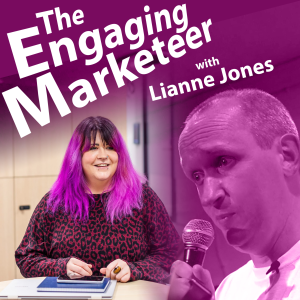
[00:29] Darren: On this week’s episode of The Engaging Marketeer, I’m going back to my hometown of Newport. I’m speaking to Lianne Jones, who is an SEO, content-writing, digital-marketing, tarot-reading witch.
I’m sure she won’t mind me describing her as that.
So, I’m going to be asking her lots of questions about how she got into the industry, what sorts of people she’s done SEO for and probably a little bit about tarot as well. I might mention witches, otherwise my daughter would never forgive me if I didn’t talk about witches to a witch.
So, let’s find out a little bit more about Lianne Jones from Newport.
[01:10] Darren: You’ve got, I believe, about 15-odd years’ experience in SEO, in what used to be back then a very male-dominated industry. It’s a little bit better now.
What got you interested, first of all, in coming into the techie world of search marketing?
[01:29] Lianne: I had no interest! I didn’t know what I was jumping into.
[01:34] Darren: Me neither. Me neither.
[01:37] Lianne: I started in 2010. I graduated in 2009. I had a degree in journalism, so my passion was writing and my path was: I was going to work for a newspaper. That was the plan.
[01:55] Darren: You knew what you were going to do. You were going to be a newspaper journalist?
[02:00] Lianne: Yeah. I hated the broadcast stuff. I did that in uni. It wasn’t for me. Video editing and audio editing made me very angry! But the writing, that’s where my passion was.
So I graduated and that was the plan. I was working in Pets at Home at the time just to have some money to play around with. I wanted to get into something as quickly as I could.
But, of course, we had the rise of online journalism at the time I was studying at university. Online journalism was going like this and newspaper journalism was going like this. Then we also had that financial crash around 2009.
So when I graduated, finding a job wasn’t particularly easy and you just had to get something to make ends meet. In the journalism world, it was a case of either you work for free, which wasn’t an option, or you have X amount of years of experience, which I obviously didn’t have.
It was only by chance that I was working with somebody at Pets at Home who knew someone who owned a hair and beauty ecommerce business. She said to me, “Oh, my friend needs somebody who can write. Are you interested in a chat with him?”
I was like, “Yeah, sure.”
So I rocked up at this little bunker, literally a bunker on a farm.
[03:36] Darren: Literally a bunker?
[03:38] Lianne: Literally a war bunker. A converted war bunker on a farm.
I had a chat with him, he seemed like a nice guy and he just wanted somebody to come in who could write blog posts and stuff for the website. I did a trial, wrote some copy for him and that was it, really.
I landed my first digital marketing job without really knowing that’s what I was doing.
I was hired as an ecommerce manager and I was doing everything. I was writing all of the product descriptions for the website, writing the blog posts, managing social media and doing press releases. But then I was also doing all the customer service and packing the stock in the back room.
[04:27] Darren: So you were in distribution as well, then?
[04:30] Lianne: It was literally just me! I was doing everything. So it was an interesting step into the industry.
[04:39] Darren: Presumably you had to learn fast, then, because there’s a big gulf between writing content for a website and setting strategies, doing keyword research, working out what paths people are taking through a website and what’s converting and what’s not converting.
How did you learn all of the other stuff while you were basically running the ecommerce business yourself?
[05:04] Lianne: Well, I didn’t do any of that strategy stuff there. I didn’t understand what I was doing. I knew I was writing. I knew I was producing stuff that people were engaging with and the aim was to get more people into the website and more people buying from us, but I didn’t know what the strategy was.
I was given keywords and I remember one day he said something about how we needed to start doing some link building. I thought, “Oh no, that sounds like having to go out and talk to people in person, like networking.”
That’s what I thought it was!
[05:48] Darren: Nobody wants that.
[05:51] Lianne: I was like, “Oh, I don’t fancy that.”
But he turned out to be incredibly toxic and narcissistic. When he started to show his true colours, I was desperate to get out. I was applying for jobs left, right and centre and I got an interview with a massive agency in South Wales.
I don’t even know how I pulled this off. They wanted to speak to me about being an SEO team leader and I literally sat in the interview and said, “I don’t know what SEO is.”
They were like, “No, you’re perfect.”
I described everything I’d been doing. They were like, “No, you’re perfect.”
I was like, “Yeah, but I’m not doing SEO.”
They said, “No, honestly, you’ve got all of the skills and qualities that we’re looking for.”
How I didn’t talk myself out of that job, I don’t know, but somehow I got it.
It was there that I really started to learn the strategy and understand the tactics, because I was dropped into the middle of a team of all these amazing experts.
I was managing copywriters, technical SEO people and SEO people, and I just absorbed everything I could from the people around me.
I was very humble and understood that I was there to facilitate and guide them on things like their time, make sure they were doing well at work and bring in the elements that I was good at.
I knew good copy and good writing, so I could advise on that stuff. I also had more of a social media edge than anyone else in the team because of what I’d been doing in the previous role.
Ultimately, I was there to facilitate and make sure they had everything they needed. So I absorbed as much as I could from these people who were the experts and started to build up my own knowledge along the way.
[07:57] Darren: What you do is actually quite rare. To find someone who has the writing ability, who comes from a journalism background, who can structure a sentence and spell, and then someone who understands the strategy and the technical changes on a website as well – often they’re very different skill sets.
From my experience, most technical people, even though they have to be able to spell to write code, can’t spell to write words! They also struggle a lot to communicate with people. I’m generalising a little bit here, but they can be very introverted, nerdy people, whereas the writers are able to communicate.
So to have those two skill sets side by side is quite rare. It makes you a little bit of a unicorn, I think.
[08:50] Lianne: I’ve come to accept that over the years. I think for a long time I didn’t realise that was the case and I’ve probably undersold myself in so many jobs.
I admit that I tripped and fell into the industry. It was never the plan. But I took it as an opportunity to learn and carried my love of writing through everything.
I did learn along the way and quite quickly got to understand how strategy worked and how I could make all of these moving parts come together to actually do what it needed to do for the client.
I’d always been really interested in marketing. I’d studied media studies and advertising and stuff growing up, and I was always fascinated by how we buy, why we buy and what makes us tick.
I think I was able to bring it all together and understand the strategy quite well.
I’m a creative at heart and creativity runs through my blood, but I also have a very analytical mind. I analyse things – overanalyse things in many cases – so I think that has been a benefit.
But I don’t think I realised how unique I was back then. I’ve never been very good at blowing my own trumpet either, so I was always happy to be in the background and let the people around me do their thing.
[10:17] Darren: How much did your skills flourish in this role? Because you say you tried to talk yourself out of it at the interview.
I’m guessing they saw something in you that fitted perfectly with what they wanted for the role, even though you didn’t realise it yourself.
What sort of skills did you learn there that you didn’t have before you went in?
[10:39] Lianne: Things like keyword research. Actually understanding how we were finding out what people were searching for was absolutely fascinating.
It’s still one of my favourite things to do to this day.
[10:53] Darren: That’s weird. Keyword research is a little bit weird.
[10:57] Lianne: Is that weird?
Some of the things you find are a little bit weird, I will admit. Some of the stuff that people are searching for…
[11:05] Darren: We’ll have that conversation in a minute.
[11:08] Lianne: But it’s fascinating. It’s fascinating to find out how people are engaging with the search engines and what information they’re looking for.
So that was a big one: learning how to do good keyword research, and not just having a list of keywords. Because then you’ve got all of these things and you’re like, “Well, what do I do with this?”
Then mapping that against a website and strategically thinking about where we actually want people to come into the website.
That was a huge learning curve for me, understanding that, and then the off-site SEO as well.
I’d unknowingly been practising a lot of on-site SEO by doing all the meta descriptions, product descriptions and blog posts, so I had a much better understanding of the on-site side of things.
But the off-site stuff? I had no idea about this link building, which turned out not to be networking, much to my relief!
[12:15] Darren: Well, it kind of is, I guess, in a way.
[12:20] Lianne: And technical SEO took me the longest time to understand. I think that was the biggest one for me.
I understand technical SEO now. I can pick up the problems, advise on solutions and there are certain things I can fix, but I don’t naturally have a super-techie brain. I’m not a web developer.
So that was the hardest adjustment for me.
[12:48] Darren: It’s interesting. I think your path is fairly similar to mine in a way because I started with an ecommerce brand. I started at GAME as the web designer for GAME.
In the department, we were responsible for, like you said, the product descriptions. I didn’t do the product descriptions; a guy called Gary did those.
Hi, Gary.
[13:11] Lianne: Shout-out to Gary.
[13:14] Darren: Shout-out to Gary!
Then we had a couple of games journalists there who were living the best life you could possibly imagine. They’d gone to university to be journalists and ended up playing and reviewing video games five days a week, eight hours a day. That’s all they did.
The lucky bastards.
[13:42] Lianne: That was the life back then. You could really throw yourself into a passion like that and make a career of it.
[13:49] Darren: You could, because there was loads of money in digital marketing back then.
People were doing ridiculous ad spends on things like Yahoo, spending tens of thousands of pounds a week just to put a banner on Yahoo, and nobody cared about the returns because it was, “Oh, we’ve got to be up there. We’ve got to be up there.”
Then the bubble burst.
I think if we were hiring somebody now for an SEO position, rather than looking for somebody who’s been tainted by an SEO agency that may well have taught them a lot of bad things – because there are a lot of bad things out there – we’d probably look for somebody who had your background.
They’ve worked in-house on an ecommerce brand or ecommerce business, which means they’ve done everything that needs to be done to promote an ecommerce business and get sales into that business.
If you weren’t good at it, it wouldn’t have worked.
So you’ve got the actual practical skills that make you perfect for SEO, even though you didn’t realise it at the time.
[15:10] Lianne: I think that’s the way I then hired as well because I was a team leader, so I was hiring people.
There would be people we’d take on who were super technical, but then there were other people where I could just see it in them.
They would have that curiosity about how people are interacting with the website, or they would have that creativity that would lend itself well to a digital marketing campaign.
So I think the way I hired was probably the way that I was hired.
[15:49] Darren: I think that’s the key word you just said there: curiosity.
You need to be thinking, “How are people interacting with this website?”
Because it’s not just about a handful of keywords ranking in Google. That’s not going to get you anything other than vanity metrics.
What are people searching for? Why are they searching for them? And, as you said earlier, what pages of the site should they come through when they’re actually searching for those things?
What’s going to make them do what you want them to do and what they want to do, which is buy a particular product, buy a series of products, subscribe to something, take a trial or enquire about something?
Where can we get them through to, and how can we devise the strategy that’s going to get them through to that?
That’s the kind of stuff you were doing without even thinking about it.
[16:45] Lianne: I think that’s what confuses people massively as well.
A lot of businesses I talk to just assume that you chuck everything you want people to find you for at your homepage.
But it is that strategy and that mapping of the whole website and understanding where the best place is to bring people in.
This is 16 years on since then, but it’s still something people find hard to grasp unless you’ve done it and seen the results.
[17:19] Darren: Yeah. I used to work for an agency in Manchester in about 2007 and their whole strategy was just optimise the homepage.
Optimise the homepage for five or six keywords, so everyone’s coming in on the homepage.
It was easy back then. They got the rankings. A lot of it was paid links from India, of course.
They got the rankings, but then the sites weren’t converting, because why would they?
Sites were ranking that probably shouldn’t have been ranking in the first place. It was artificial through paid links and everyone was coming onto the homepage, so they weren’t actually converting anyway.
The companies weren’t making any money, but the agency had done what it said it was going to do: get you rankings.
It was such a bad way of doing it, which is why we left to start our own business. We just hated the way they were doing marketing in the first place.
[18:19] Lianne: There are a lot of people like that.
[18:22] Darren: There are still.
Which is bad for businesses because they’re getting ripped off by people who, quite frankly, are selling them snake oil.
[18:32] Lianne: Yeah, on both sides.
I really feel for the businesses who are being bought into, “I’m going to rank well, I’m going to get loads of business,” from tactics that are snake oil and aren’t going to sustain for the long term.
But also, for people like us, it has tarnished our industry so badly that I feel I’m constantly having to almost prove that I am someone you can trust.
There are certain career paths where there’s natural distrust.
[19:11] Darren: Lawyers. I was just thinking lawyers as you were saying that.
[19:16] Lianne: Lawyers, estate agents…
[19:19] Darren: And journalists.
[19:22] Lianne: What was I thinking?
[19:24] Darren: To be fair, estate agents – most of them.
[19:28] Lianne: It’s true!
But we’ve had to really work, I think, to prove those of us who are the good guys and the good girls can be trusted, because so much harm has been done in the industry.
It’s a shame because it’s such an exciting area to work in. I mean, I’m a massive nerd, but I think it’s so exciting.
[19:58] Darren: As you mentioned guys and girls, then, let’s talk about that.
You’re about empowering women in this industry as well.
It was very, very heavily male-dominated. It still is to a degree. How have you found that, and the changes over the years?
[20:20] Lianne: When I started out, I didn’t really realise that was the case because the ecommerce company I worked for, the guy who ran it was gay and any of us who ended up working there were female.
So I didn’t see it at that point because of the industry I was working in.
Although I look back and reflect on that first agency role, and they hired people based on their talents, quality and skills – it wasn’t based on gender – it was very heavily male-weighted.
I was the only senior member of the team who was female for the longest time, and still I don’t think I really saw it then.
But there are a few things I look back and remember where I had to work so much harder than the males in the company just to be taken seriously.
From a client’s perspective, my advice, strategies and leadership were all very well trusted in the agency by the people above me.
But I remember this one particular meeting. It was with a car dealership, which says it all.
It was me and I took two male members of my team. Most of the female people back then, I would say, were copywriters. I know it sounds stereotypical, but it really was. If there was a woman in the agency, she was usually a copywriter.
Anyway, I went to this meeting with two members of my team and this guy was relentless.
We were there to support his business and help him grow, and we really were doing that as well. We went with suggestions and had the results to show him, but he was just picking for a fight.
He was obviously used to being in that sales environment where everything was very bro-ish.
I almost felt I had to go toe-to-toe with him in the ring just to get him to understand that we were on the same page and we were doing everything we could for his business.
So much so that, at the end of the meeting, he slapped me on the back and went, “Well done, love.”
[22:13] Darren: Wow.
[22:15] Lianne: He would not have done that to them.
He was getting quite intimidating and the two guys I’d taken along suddenly lost their voices. It was me doing all the talking.
But he wouldn’t have done that to them. It was me he was trying to go at.
[22:36] Darren: All the expletives!
And you like to think people like that don’t exist any more, but they do.
[22:44] Lianne: They very much do.
Even since I launched my business almost three years ago, I had some clients who came across with me because they’d lost their support when the agency I was working for went bankrupt.
They had obviously chosen to follow me and come and work with me.
There was one person in particular who kept questioning my tactics and my strategy, even though we’d been working together under the umbrella of the previous agency.
Because I was on my own now, he suddenly doubted whether I knew what I was talking about.
He’d ask for my advice and then toddle off and speak to somebody else who had worked at the agency.
But we were friends, so we would speak about it and he would confirm that what I’d said was correct.
Then it was, “Okay, we’re doing this.”
[23:55] Darren: There are a lot of clients like that though, aren’t there?
Even though they’ll pay for your advice and pay you to do the work for them, they’ll still question everything you say.
And now, of course, they’ve got ChatGPT to ask the questions to.
They’ll be asking ChatGPT, “What would you do with my SEO strategy? This is what my SEO has said. Is that correct? Now draft me a response to send back to the SEO so I can question everything she’s told me is correct.”
Do you get that kind of stuff as well?
[24:28] Lianne: Not so much any more because I’m quite selective over who I work with now.
There have been a few situations. I’ve been really lucky, I must be honest. I’ve attracted some good people and good clients over the last three years.
But there have been a few situations where those alarm bells have gone off and I’ve thought, “This is not going to be the best working relationship.”
So now I recognise those very early and head it off at the pass. I don’t tend to work with people like that.
I have had clients where they’re just nervous. It’s not so much that they’ll go to ChatGPT and question whether I’m right or wrong. They just get nervous because there’s so much change going on that they don’t understand.
And you’ve got the cold outreach that’s very prevalent in our industry, where they’ll have emails from overseas saying, “We can improve your SEO. We can do this.”
Much like we were talking about earlier with the links.
That makes them nervous because they think, “Am I spending my money in the right place? Am I doing everything I can to be as visible as possible?”
So I get that side of things, but not so much the, “ChatGPT said this.”
[25:53] Darren: The cold emails have existed since email started.
As soon as the very first email was sent, there was a spam email following it straight away saying, “We can do your SEO for you.”
I saw, I think it was John Mueller or maybe Matt Cutts from Google years ago, saying even Google gets these emails.
[26:14] Lianne: Oh, that’s hilarious.
[26:17] Darren: It is ridiculous.
What do they say? God loves a trier.
[26:22] Lianne: God loves a trier.
[26:25] Darren: I don’t think he does, though. That’s the thing.
Now, with AI – which we are coming onto slowly here – there are a lot of platforms out there that will do your SEO for you, or say they will.
There’s one I see advertising on Facebook and LinkedIn called Hike, where it’ll do your SEO for something like 50 quid a month.
It’s like, “I don’t need to hire an expensive SEO because Hike does my SEO for me.”
Where do you stand on the use of AI within SEO?
Obviously it has a place in terms of researching, checking stuff and using audits, but where do you stand on what other businesses are using AI for in SEO?
[27:09] Lianne: I’ve tested it quite a lot and I’ve tried to understand how well AI can be used for SEO.
I just don’t feel that we’re there.
A lot of the suggestions it makes… We’ve got to bear in mind with AI as well, it’s a system that is built on past data. It’s not necessarily current data that is fresh and live now. It’s based on a snapshot rather than something being published today.
I’ve tested it for keyword research. I do use it to bounce ideas. That’s where it comes into play in my business.
If, for example, I’ve got something that’s super niche and I’m very close to the coalface, sometimes you need to take a step back to get a bit of inspiration.
So I’ll use it to bounce ideas sometimes. I might use it to get seed keywords and then I’ll go and actually research the viability of those, whether people are actually searching and go down that whole rabbit hole myself in the SEO tools.
Or, if there’s something super technical going on with a website, I do find it useful for those purposes.
I can say, “This is happening. I think it is this, but can you check the code? Can you check this for me? Am I missing something?”
When you’re working as effectively a solo SEO and you haven’t got a big team of experts around you, like I did when I started my career, I find that really helpful because you’ve got that bouncing back and forth which I think we all need.
But as for strategy, even the keyword ideas it comes up with and the way the copy is written, none of it is quite good enough to allow you to be competitive enough in this very fast-evolving world that we live in.
Does that make sense? I feel like I just waffled.
[29:00] Darren: No, it makes perfect sense.
And I love the way you started with the snapshot from search engines already being out of date.
It’s like that old adage that today’s newspaper is already yesterday’s news.
[29:15] Lianne: Yeah. Take me full circle back to journalism. Tomorrow’s chip paper.
[29:22] Darren: I’ve completely forgotten what I was about to say then, but I think it was very poignant and very powerful.
So imagine I’ve said something very powerful.
[29:32] Lianne: Yeah, I felt that, what you said.
[29:35] Darren: Did you? Thank you. I felt it as well.
No, it’s about using…
Yeah.
You’ve got something like Hike, for example. There are people using AI purely to do their strategies for them and it’s doing everything for them.
Clearly it’s not working.
That was it. It was a stat. I gave this at a networking meeting last week.
Search Engine Land did a survey of, I think, 45,000 results or 45,000 pages, and it deemed human-written content was eight times more likely to rank number one in Google than AI content.
Even though Google says, “We don’t have a problem with AI content.”
For years Google said, “Don’t use it,” and then it changed its mind and said use it if it’s useful and adding value.
But, yeah, eight times more likely.
So if you are one of these people listening to this and you’re going out there and using ChatGPT to write all the content for your website, bear in mind human-written content is eight times more likely to outrank you if that’s what you’re doing.
So why are you doing it?
[30:48] Lianne: What I will say as well is some of my clients who do content at a larger scale do use me for AI-assisted content, but it’s got to be human-edited.
You can use it to pull out the bare bones and cut time on your research, but again, all it is really doing is pulling from everything else that is already in the search engines.
You’ve got to have that human element of who is actually ranking well, what they’re doing to allow them to rank well, how we make sure we replicate that and do better than that to outperform them, and how we make sure we sound like our brand as well.
As much as you do all of the prompting – and I’ve had many an argument with ChatGPT – it still cannot replace the personality and the way we, as people, can adapt to different tones and speaking to different audiences.
It just can’t match it.
[31:46] Darren: Absolutely not.
And then you’ve got the issue of model collapse as well.
At the moment, more than half of the content being added to the internet is written by AI, and as you’ve said, when you ask ChatGPT to write something, it’s going through and looking at what already exists.
If half of what already exists was generated by AI, it’s referencing itself.
So it’s looking at itself to bring new content, which then references itself, which then brings new content.
Eventually – I’ve talked about this before – it’s like having a VHS tape.
If you’ve ever used a VHS tape…
[32:28] Lianne: I have. I am old enough.
[32:31] Darren: You didn’t look it. I didn’t want to presume!
If you copy a tape onto a tape onto a tape onto a tape, the quality is going to degrade every single time.
It’s the same with AI content.
If you’re using AI content exclusively, it’s learning from AI, which is learning from AI, which is learning from AI. The quality is going to degrade and you’re going to get model collapse.
Which is why human-edited content or human-written content is outperforming it.
[33:09] Lianne: What’s interesting, though, is I feel I’ve spoken about this a couple of times recently and I’d be interested to see what you think about it.
ChatGPT came out and everybody was super excited that there was this thing that could do all of our work for us, especially when we look at something like content writing.
We saw the impact of that in the agency I was working at because probably two-thirds of our workforce were writers.
We were heavily a content agency and we really valued human-written content.
A lot of our clients – it was an affiliate agency – were hobbyists.
So something came out that was more cost-effective and they went, “Oh, I can do this for myself.”
The agency went quite quickly downhill and we couldn’t respond fast enough.
Back then everyone was so excited about what something like ChatGPT could do.
But I feel personally, and I’ve seen this on LinkedIn and chatting to people, that we’re pulling back a little bit more now and realising, “Oh no, I think the way it was before was actually better.”
[34:18] Darren: I think you’re right.
Affiliates especially – because I’ve been involved with affiliates for 25, 26 years now – are always looking for a quick way to do something.
I remember in the mid-2000s Amazon released an API where you could basically clone a whole section of an Amazon store on your website.
I had a website that had DVD reviews and it was built up on hundreds and hundreds of DVD reviews.
I was able to take the Amazon API and build a web store on the back of this DVD website, which is still live now. DVD.net doesn’t get any new content, but it’s still live.
I created a DVD browser store on the back of that using my affiliate ID, so anybody who went through it would be able to buy content from it.
But, of course, Google hated that, because an affiliate site is thin content or non-existent content. It’s essentially a duplicate of Amazon.
So all these Amazon duplicates cropped up that were affiliates, and the affiliates had the dream of, “I’m going to make hundreds of thousands of dollars a week doing absolutely nothing because I’ve just cloned this site.”
“Oh, now I’ve got to fill it with content. Bugger.”
So they’d get content writers, or use Fiverr or whatever was available at the time, and fill it with content to try to get it indexed and get people to buy.
Now ChatGPT is able to do it all again.
“I can fill the whole lot in one go.”
And yes, you can. But that’s not going to work for Google because it’s still not adding value to the user.
At the end of the day, that’s what your website needs to do. It needs to add value to the person landing on it.
If it’s just a duplicate, a clone, a scrape or AI content that’s churned out very quickly, it’s not giving value.
So are you giving value to your user?
If yes, then Google is probably going to like it. If no, it’s probably not going to like it.
But, yeah, the affiliate industry has always had that problem.
[35:58] Lianne: Yeah, because it’s quick. It’s, “How can you make money as quickly as possible?”
[36:05] Darren: With no overheads.
[36:08] Lianne: Yeah, and without actually handling product.
It’s the dream, right? That semi-passive income everybody dreams about.
I do wish that, with the skills I’ve got, I’d got into the affiliate world earlier.
I started working there in 2021 and then we went under in July 2023.
So I was only working in that sort of space for a short time, and I wish I’d got onto that bandwagon much, much earlier because I’d probably be living a life of luxury now with the skills I had and what I was able to do.
[36:39] Darren: Affiliate can be a very, very fast burn.
What works this month might not work next month.
I remember the biggest month I ever had on affiliate earnings. I think it was May 2007, and it was Google AdSense.
I earned, I think, $45,000 in a month on Google AdSense.
[36:58] Lianne: Nice.
[37:00] Darren: Just on clicks on a website.
It was because I had quite a few Transformers websites and the very first Transformers movie, directed by Michael Bay, was coming out.
The trailer had just come out and people were looking to see, “How are these things going to look? How is a Transformer going to look real?”
So I was getting tens of thousands of visits to this website because it was a really good domain name.
It had loads of AdSense on it and I was getting loads of clicks.
I was earning sometimes $150 a day just through doing nothing.
I’d log in every day in work and check. I even had a little counter at the top because there was a widget you could get on your desktop and it was showing my live AdSense earnings.
I thought I was going to be rich. This was going to last forever.
[37:37] Lianne: You’d made it.
[37:39] Darren: I’d made it. Exactly.
I was never going to have to work again. I was going to hand in my notice. Brilliant.
But it lasted about a month and a half and then went right back down again, because there was no real content to it.
It was purely seasonal search traffic.
So, yeah, that’s my affiliate journey.
[38:00] Lianne: Nice. But it’s like gambling, isn’t it?
[38:05] Darren: Yeah. It’s very all-or-nothing in the affiliate world.
[38:09] Lianne: It is exciting.
I do wish I’d been able to make the most of it, had I known about it much earlier than I got involved.
But there we go. It is what it is.
[38:19] Darren: It’s soulless. You’re doing the right thing.
You’re helping businesses that have a genuine service or product, which is important.
Let’s talk about what you do for women. How do you help women in your industry?
[38:33] Lianne: When I started my business, the goal was just like it is when you start a business: “I’m just going to help everyone.”
All the networking gurus tell you that’s the worst thing you can do and all the business strategists tell you it’s the worst thing you can do.
But that was my plan: just help people be more visible online.
Then, in 2024, I put myself forward for an award at the Woman Who Solopreneur Awards in October.
I nominated myself. I thought, “I’m not going to get anywhere with this. Whatever. We’ll nominate myself.”
I got through as a finalist, which just blew my mind. I wasn’t expecting that at all.
I went along to the awards and that day really changed my business because I was in a room full of all these amazing, inspirational women.
I’ve always very much been a person who likes to hold other people up and see other people doing well.
That’s why throughout my career I was quite happy being in the background doing what I did, but seeing other people do really, really well on my team.
It gave me so much joy when people were able to be promoted or have pay rises.
But being in that room on that day, meeting all of those women, hearing the different stories and seeing the awards people were winning just changed things for me in my business.
I got called out as One to Watch and I’ve got a certificate up on my wall.
It had only been just over a year since I started my little business, and that recognition meant everything to me.
But more so, I got in the car, still crying from doing well, and drove home thinking, “This is what I want to do.”
I want to be helping all of these amazing women who have these ideas and these businesses. They’re changing the world.
I want to be able to support these women and help them shine.
That’s where things started to shift.
I still have some amazing male clients who I absolutely love working with, but, not to get too political, in the world we live in at the moment, where it feels like we’re moving backwards in a lot of the progression we’ve made over the years, I feel it’s important to help people who are more of a minority thrive in whatever it is they want to do.
That’s really where my passion lies now.
Helping female business owners, helping queer business owners, just helping people share their voice and make their impact online.
—
[38:57] Darren: Okay. And do you think – it’s a loaded question – enough is being done in this industry?
[39:06] Lianne: I feel like I’m probably far too removed from that now.
I don’t know that there is enough being done to encourage women and empower women to step into the technical side and feel that they are capable, even if they’re in a room full of men.
But I obviously have the privilege of not having to work in an agency any more.
[39:33] Lianne: Then I see it every day on LinkedIn, especially with all the chat around AI.
There are a lot of predominantly male voices I tend to see who have popped up out of the woodwork and they’re suddenly experts in AIO or GEO, and there’s no background whatsoever in search or digital marketing, or anything that remotely makes them an expert.
[39:57] Darren: Yeah, I’ve seen so many of them.
I have a little look through their career and I’m like, “You’ve just had a little play around with ChatGPT and decided, yeah, I can do this. I’m going to run this business.”
So, do you call them out, though?
[40:17] Lianne: No, because I cannot be bothered lending my energy to the drama.
[40:22] Darren: You see, I could be bothered.
[40:26] Lianne: I’ll send them your way.
[40:28] Darren: I could make it my mission.
[40:29] Lianne: I did share a post yesterday on LinkedIn.
There was a webinar I went to recently and I was really excited because it was all about how to succeed in AI search.
I was like, “Cool, let’s go along. Let’s see what they’ve got. Maybe they’re talking about something I haven’t yet heard.”
All it was was this guy talking to these small businesses like they were children, telling them how SEO was dead, telling them how AI was the future, and then proceeding to share the tactics and basics of what they needed to do.
Guess what?
All of those basics were traditional SEO tactics.
I was like, “Amazing. Genius. Round of applause for you.”
[41:12] Darren: Who would have thought?
[41:12] Lianne: I know. Who would have thunk it?
[41:15] Lianne: So, back to your original question, I don’t know if I can really answer whether enough is being done to support women in the industry.
I do feel there is a gap in empowering women to step into the technical side.
And I very much see on LinkedIn that the loudest, most opinionated voices around the shifts in search seem to be male-dominated voices.
That’s where I love the likes of – are you aware of Nikki Pilkington?
[41:46] Darren: Nikki Pilkington? I’ve not seen her.
[41:50] Lianne: Her strapline is “Non-Wanky SEO” and she calls them all out.
She does the things that, if I had the energy to lean into the drama, I would do.
There are some strong female voices I follow and love engaging with.
[42:02] Darren: I’m going to search her out immediately. I love that.
[42:08] Lianne: Oh my God, you have to.
She’s not too dissimilar to me. She’s got crazy hair and lots of bright colours going on.
But she’s awesome and she’s been doing it longer than me. I think she’s been in the industry for about 20 years.
She’s also been there, seen it and done it.
[42:28] Darren: I don’t want to generalise here, but it seems to be a female trait.
As you said, you don’t want to take part in this calling people out because it’s confrontational.
It seems there are a lot of women who don’t want to do that. They want to just get on with what they’re doing and become experts in what they’re doing.
But you also said you don’t blow your own trumpet, which men do. Men are quite happy to say, “I’m an expert.”
[42:59] Lianne: You can say that. You’re a guy.
[43:01] Darren: Exactly. I can say I’m a guy.
“I’m an expert in this. Fantastic. I’ve been doing it for 45 minutes now, which makes me a genius expert.”
So, should women be more boisterous about what they do, or is it just something you don’t think you need to be doing?
[43:20] Lianne: That’s such a tricky one.
A big part of what I do in trying to help women be more visible online is I want their voices to be seen and heard.
I want them to be sharing their expertise, sharing their opinions and allowing themselves to connect with the right people.
[43:40] Lianne: But the backlash that can come with people not agreeing with what you’re saying, or just thinking that you’re wrong…
For women, we live in a very judgmental society – for all people – but I think for women in particular, you might get called out because of how you look or how you dress.
There’s so much more nuance that comes with it that I think sometimes keeps us smaller than we should be.
[44:15] Darren: There’s a lady I know who I used to work with, Sadie Sharon – if she’s watching – who was called a “feminazi” by Piers Morgan once for one of her appearances.
[44:28] Lianne: Piers!
[44:31] Darren: He’s not one of us, you know.
I can only apologise for Piers Morgan.
But there we go.
It’s the old adage that if a little boy is noisy and talkative, he’s assertive and confident. Whereas if a girl does it, she’s bossy.
[44:49] Lianne: I’ve been called bossy so many times. My mother would call me bossy growing up.
Those things don’t help.
[44:59] Darren: No.
Do you know, I did a podcast interview with a hypnotist, which I’ve just edited today, actually.
He was talking about how that is a form of hypnosis.
If you tell somebody they’re bossy, they will believe they’re bossy.
The example he gave is that if you’re a parent in a shop and you tell your child, “You always act up in this shop. You always make a…” they will automatically do it.
That is a form of hypnosis. You’re conditioning people to believe that.
[45:23] Lianne: You absolutely are.
[45:31] Lianne: My other line of work is my spiritual work, and I very much now work with the power of words, the things we say and the impact they can have.
I find there’s an overlap almost between my work.
I might work with an amazing businesswoman and hear her say something like, “Oh, I don’t deserve that,” or… I can’t think of an example now.
But I will hone in on those words and try to help people reframe that as well.
Those words, the things we hear when we’re really young, the things we say about ourselves now and the things we do are so important.
They carry so much magic and so much power.
They shape our beliefs. They shape our mindsets.
[46:17] Darren: Yeah, they do.
Well, let’s talk about your spiritual stuff then because we’ve probably got about 15 minutes or so left.
You do tarot as well, which is very different to digital marketing, but you say there’s a synergy.
So go on, explain how they’re linked.
[46:33] Lianne: I don’t know if I would say they were super linked.
But, for me, my awareness of energy helps me attract the right people into my digital business.
[46:44] Lianne: I’m also a big believer that I’ve put so much hard work, so many long hours and long weeks into my digital business since I launched it.
But I do believe that just knowing, feeling and believing it was going to work out has been a big part of my success as well.
I’ve had those doubts creep in: “What if it doesn’t? What if it doesn’t?”
But I’ve always felt, “No. I’ve got this and the universe has got my back.”
[47:07] Lianne: I really felt that when I was made redundant because I’d wanted to work for myself for the longest time.
I never fit into the corporate world. I was always the weirdo. In my face, I never quite fit into the corporate setup.
So I’d always wanted to work for myself, but having the bravery and the guts to take that step was not something I’d ever got around to.
When I was made redundant, I just felt it was the universe giving me a big kick up the butt and saying, “Go and do it for yourself.”
So that’s what I did.
[47:43] Lianne: I’ve really held onto that belief that I can make this work. I will make this work.
From that point of view, I suppose there is a lot of overlap for me, because it’s been holding onto that belief and manifesting the good things.
I’ve got some really cool clients now who I feel so grateful to be working for and working with, and I do feel that I’ve manifested that to a certain extent.
It’s the energetics for me that flow between both of the businesses.
[48:14] Darren: I think that probably goes some way to explaining why you are what I described earlier as a bit of a unicorn.
[48:22] Lianne: A bit of a weirdo.
[48:25] Darren: You could say weirdo if you like. Unicorn, weirdo – they’re both the same.
The fact you have the creative side for the writing – most SEOs can’t write, most SEOs can’t spell and most writers wouldn’t do the technical.
Whereas you’re also doing the data, statistical, fact-based work of SEO, yet you’re also into the spiritual aspect of tarot, and they are complete opposites to a degree.
So it kind of reflects your personality, that you are both of those things coming together at the same time as well.
[48:58] Lianne: Yeah. And so many people try to box me in and they will say, “Which business do you love more?” or, “Which one would you like to focus on?”
[49:05] Darren: Who’s your favourite child?
[49:08] Lianne: Yeah!
I’m like, “No, I love having both of these things in my life.”
It makes my brain happy that I can go from writing copy or looking at the journey of a user in Analytics to shuffling my tarot cards.
It just makes me happy to have that variety.
I have no doubt that I’m neurodivergent, and having the ability to switch between those different things keeps me motivated and keeps me engaged.
[49:36] Darren: I’ve never had a tarot reading.
[49:41] Lianne: Okay.
[49:42] Darren: But I’ve seen it a lot in films, obviously. I’m sure I’ve seen it very misrepresented in films.
How does it work?
[49:49] Lianne: They’re just nudges and kind of encouragement from your subconscious.
The way I work with them is I use my own intuition. I don’t read the tarot cards based on what their traditional meanings were because I always feel like that’s one person’s interpretation.
Much like the world of SEO, I want to see it, I want to do it, I want to test it myself.
[50:21] Lianne: So I use my own intuition as to how the cards make me feel for the person that I’m reading for.
But often they’re just a way to uncover the things that we already know, much like hypnosis or therapy.
It’s all of this stuff that we’ve got buried inside us anyway.
And it’s just encouraging it out and giving you a little nudge to say maybe you need to make that decision, or you need to look at the people who are around you and check that you’ve got the right people in your corner and the right people supporting you in life.
They’re just nudges to the subconscious, I would say, for anyone who isn’t familiar with tarot at all.
[50:59] Lianne: It’s not going to tell you in six months’ time you’re going to win the lottery.
Don’t get me wrong, the way I work with the cards, there will be things where I might draw a card and go, “Ooh, you might want to put aside a little bit of money for the next few months because it looks as though there are going to be some expenses going out.”
So it’s preparing people for what might come. And it can be that accurate. It can be that specific.
[51:26] Lianne: I’ve been doing this for not as long as I’ve been in SEO, but I’ve been reading tarot for, I reckon, about 13 or 14 years.
I started when I was in that first agency role and I’ve read for a lot of people by this point.
The feedback always blows my mind because you read for someone and they think, “Oh, there’s no way. There’s no way that’s going to happen.”
Then you read for them again next time and they say, “Oh my God, all of that stuff that you said has now happened, and there was no way I thought that was going to happen.”
And it did.
[52:02] Lianne: So it blows my mind how it works.
But it’s all energy and it’s all this stuff that we’ve already got inside us.
We’ve got so much power, I think, and so much knowledge inside us that is just untapped day-to-day because we’re in the grind and we’re doing the do.
The power of our own minds and harnessing our own energy, I think, is phenomenal.
[52:27] Darren: Which, as you say, is probably linked to hypnosis and energy as well because, as you say, we condition ourselves and we don’t realise it, or we are conditioned by our parents and our surroundings and we’re completely unaware of it, which is how hypnosis works anyway.
Right. Every time I get somebody on here who does SEO, I will always ask them something along these lines.
[52:48] Lianne: Okay.
[52:48] Darren: What do you think the future holds for the industry?
[52:53] Lianne: What do I think the future holds for the industry?
Gosh, that is such a big question, isn’t it?
[52:57] Darren: I know. It’s huge, isn’t it?
There’s not long left as well, you know.
[53:01] Lianne: So I need to talk fast!
I think SEO is dead.
No, I’m joking.
[53:10] Lianne: I don’t think that SEO is going anywhere. It is a continuous evolution, as it always has been.
I think we need to be far more aware of people starting their user journey in different places.
I know we are more aware of that, but I think that’s going to continue to evolve.
[53:33] Lianne: With things like TikTok blowing up, and a lot of people shopping on TikTok now, we have to be far more mindful of the businesses we’re working with and helping their visibility.
Where are they found online, and how do all of these different platforms fit into that user journey and that buying funnel?
I think that is a real key thing for the future of SEO: search engine optimisation is platform optimisation as well.
It is buying-journey optimisation across so many different touchpoints.
[54:07] Lianne: Branding as well, I think, is going to continue to be so much more important than ever.
You have to prove to Google – if we look at the E-E-A-T guidelines, for example – that you are a real, genuine brand.
I think that is harder than ever with the rise of AI because everybody is popping up all the time with their businesses.
So being able to prove that you’re genuine and you’ve got real value to add to people is going to continue to be paramount, I think, in the world of SEO.
[54:37] Lianne: What else do I think? What else? What else? What else?
I think there’s got to be an evolution with things like Google Analytics.
I don’t feel that it adds the value now that it once did.
It is still the single point that we can get the most information we can from a website, I guess, because it is what is embedded in the code.
But there’s got to be some evolution there with Google Analytics because I just don’t think it is pulling its weight at the moment.
[55:09] Lianne: I think there are so many tools that are popping up to try and compete as well.
Google is going to have to pull something out of the bag that is bigger and better than the current iteration that we have of Google Analytics.
And I do think there’s a certain element of backpedalling as well.
[55:24] Lianne: I think we will see changes. Yes, people are searching differently and that’s not going to go anywhere, but that’s always been the case.
We had voice search, we had Mobilegeddon, we had all of these changes that shifted how people were searching.
That is going to continue to evolve and there will be new platforms and new ways of searching coming up.
In ten years’ time we’ll probably have screens in front of us and we’re just doing this to search, like Minority Report.
[55:52] Darren: Yeah, yeah.
[55:54] Lianne: But I do think there is more of that connection in SEO with the human, and I think that is going to come full circle and become more important moving forward as well.
[56:06] Darren: And there’s a lot of stuff that comes in over the years that actually doesn’t work.
[56:10] Lianne: Yeah.
[56:10] Darren: Like when I was at GAME, for example. Was it Sky Active and NTL? They had shopping platforms on the TV and everybody thought that everyone was going to be buying on the TV.
“The internet’s not going to be around forever. It’s going to be TV shopping from now on.”
[56:26] Lianne: Yeah.
[56:27] Darren: And that just died.
[56:29] Lianne: Yeah. Just died.
[56:30] Darren: I don’t know if you do – do you watch anything on Amazon Prime?
[56:34] Lianne: Yes, I do.
[56:35] Darren: So you know we’ve got that now in a different form. The adverts there will be, “Add to your basket,” while you’re watching stuff.
I have not done that once in all the shows I’ve watched.
[56:43] Lianne: Nor have I.
[56:46] Darren: No.
[56:46] Lianne: But there will be people who do.
[56:48] Darren: This was a website you navigated with your TV remote and it just didn’t work. It didn’t work.
So, yeah, I think AI could go the same way.
I’ve always got a problem with the whole branding of search engine optimisation because you’re not optimising a search engine.
Generative engine optimisation: you are not optimising a generative engine.
You are optimising yourself, your brand, your platform, for others.
[57:16] Darren: So there isn’t – and I’m going to get people saying no – there isn’t really a difference between SEO and GEO.
There isn’t really a difference.
You’re just optimising a thing – your website, your platform, your social media, whatever it may be – for different platforms.
So you’re optimising it for Google, you’re optimising it for Bing, for Yahoo, for ChatGPT, for Claude. You’re optimising it for all of them.
It is one all-encompassing thing, and different things work slightly differently in different places.
[57:46] Darren: So yes, the fundamentals of SEO work for AI. Of course they do.
But the fundamentals of SEO have always worked slightly differently for Google than they do for Yahoo.
Often things that you do are the opposite.
You just need to be aware of all of these things, aware of all of these platforms.
But there are people online who go, “Oh, SEOs have come on and they’ve started talking about GEO as though it’s a thing and they’ve branded it.”
It’s nonsense. It’s nonsense. It’s not really a thing.
[58:09] Lianne: It’s because people are looking for it.
[58:11] Darren: That’s what SEO is all about.
It’s creating something that people are looking for so that they find you and they see you’re the expert in it.
That’s the whole industry in a nutshell.
Anyway, I don’t even know why I started ranting about that.
[58:22] Lianne: I might have that effect on people.
[58:25] Darren: I think it happens. It happens.
Right, we are pretty much out of time.
So, Lianne, if anyone is listening to this thinking, “I want to find out more about Lianne. I want to find out more about her agency, what she does, who she helps, or even tarot,” what’s the best way for someone to get in touch with you?
[58:47] Lianne: So, at the moment, for Quartz Digital, which is my digital marketing agency, the best way to find me is on LinkedIn or via the website.
I’m going through a fun new rebrand at the moment, so everything will be shiny and new very, very soon.
[59:03] Lianne: For Spirit of Sapphire, which is my spiritual brand, I’m like a rash. I’m on all the platforms sharing my knowledge.
I’m on all the platforms for both, to be fair, but I’m far more active with social media for Spirit of Sapphire.
So you’ll find me on TikTok talking all things witchy and wonderful, on Instagram, and I also have a website as well.
I would love to chat to anybody who wants to pick my brains or talk about all things nerdy and witchy.
[59:32] Darren: Nerdy and witchy. I love that. That’s something my daughter’s really into.
So, Lianne, thank you very much for being a guest on The Engaging Marketeer.
[59:41] Lianne: It’s been lovely. Thanks for having me, Darren.
[59:44] Darren: You’re welcome.